
Now that the Bartz settlement has passed some initial judicial hurdles and is moving along, with important deadlines approaching (opt-out and objections are due January 15), we thought it was worth a re-examination of how the settlement payouts may work out.
We wrote an earlier take on the payouts here and we have posted a FAQ page about the settlement (including some considerations for authors regarding filing a claim, opting out, or objecting).
The following reviews some recent developments on the settlement funds, claims, and potential payouts (sprinkled with, frankly, a little bit of speculation).
How much will the lawyers make?
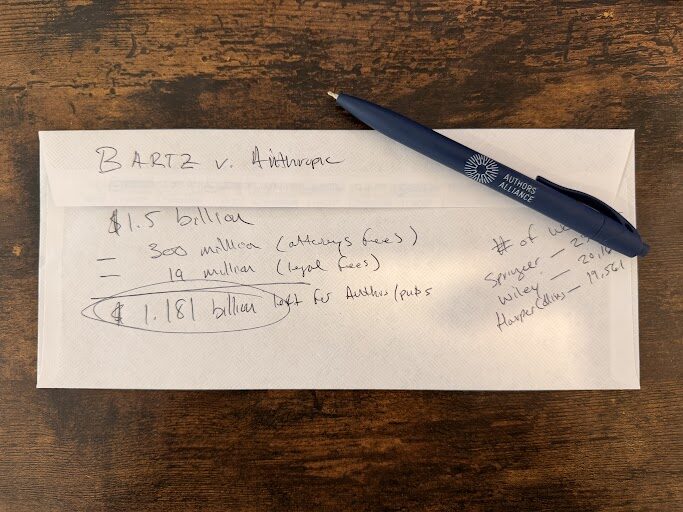
On December 3, the class counsel filed a formal request with the court, accompanied by numerous supporting documents, for their share of the settlement. The total request amounts to $318,999,422, or about 21.26% of the total $1.5 billion settlement. The request breaks down as follows:
- $300 million in attorneys’ fees
- $1,969,421.75 in litigation costs (expert witnesses, travel, legal research costs, etc.)
- $17,030,000.00 in future litigation contingency funds held aside for use as they are incurred
The request also formalized a request for a fee to the three named authors who served as class plaintiffs, at $50,000 each ($150,000 total).
$1.5 billion is a large pot of money from which to draw attorneys’ fees, and as Judge Alsup has expressed through the settlement process, there is some concern that the settlement could attract “hangers on” with so much money at stake. It remains to be seen if the court will approve this request.
The $64,935/hr question?
Earlier this week Anthropic objected to the proposal, pointing out that the split of attorneys’ fees ($300 million) contemplated $225 million going to class counsel, while the remaining $75 million would be split among three other non-class counsel that have purported to act as “publishers coordination counsel” and “authors coordination counsel” (it remains unclear to me why authors needed separate coordinating counsel since the lead plaintiffs are authors themselves and class counsel already has this responsibility). As Anthropic points out, these firms seemingly contributed little to resolving the litigation – one firm, for example, billed only 231 hours and is requesting a $15 million dollar payout ($64,935 an hour! Good work if you can get it).
Anthropic takes no position on the overall attorneys’ fees payout, but does encourage the court to consider a methodology that would give it tighter control and more information about the class counsel’s actual expenditure of time. I hope the court will take these concerns seriously and preserve as much of the settlement as possible for the intended beneficiaries.
It’s important to recognize that every dollar spent on legal fees is money taken out of the settlement that does not make its way to authors. That said, the overall request isn’t wildly out of line with what you might expect in a class action suit, so I would not be surprised if the overall award amount is close to but perhaps slightly less than the $300 million requested. The reality of class action litigation is that these suits are driven by class action firms that bring them because they expect to be paid handsomely. Even when one considers the total hours all the plaintiff-side law firms have devoted (26,191 hours so far) and assumes generously that they would work another 20,000 hours to bring the settlement to completion (so, 46,191 hours), that would result in a payout to the law firms equaling about $6,500 per hour. Pretty remarkable. As Anthropic points out in its filing, “Courts have held that it would be ‘ridiculous’ to award fees that would ‘translate to more than $4,900 per hour.’ ” The Author Guild author income survey data showed respondent authors in commercial markets make about $25k per year. If the attorneys in this case rake in an average of $6500/hr, that means the law firms, with about four hours’ worth of work, would be earning the equivalent of those authors’ annual income.
How much to rightsholders?
Assuming the attorneys’ fees will come out to something close to the request above, that would leave about $1.18 billion to be allocated among class members. Given how the settlement is structured, this would largely be money split between authors (the original class as identified in the original complaint) and publishers and other rightsholders. Assuming further that the payout would be divided equally among all 482,460 works in the suit (an assumption that may be faulty, as explained below), $1.18 billion divided by the 482,460 works yields a payout of approximately $2,445.80 per work.
How much to publishers?
One of the most dramatic turns in this litigation was when the class was dramatically broadened by the court by certifying a class that includes not just authors but all rightsholders that own a reproduction right in the works on the works list. This has meant that the suit is now one that includes both authors and publishers. So how much of the settlement is likely to be paid to publishers?
Searching the publicly available works list, there are all sorts of problems with trying to make definitive statements about how payouts will be worked out across publishers. As you’ll see if you search the list, many works are associated with multiple publishers who may have competing claims to the reproduction right in a given work. Additionally, publishers buy and sell titles (or are bought and sold themselves), making it difficult to come to firm conclusions about who owns what rights. In addition, some titles are associated with imprints that aren’t always connected in the works list to the legal owner of rights.
That said, for at least the larger publishers I think we can at least get a rough sense of the scale of expected claims that some of the larger publishers might make, as well as some idea of what that might mean in terms of payouts to them from the settlement.
To determine a potential payout figure, I multiply $1,223 per book by the number of works associated with each publisher searched (recall that for non-education works, the settlement sets a 50/50 default split between publisher and author, so this assumes half the $2,445.80 payout per book. For simplicity, I assume that the default applies and that one publisher holds the entire “publisher” share). Searches were based on publisher name for 10 of the largest publishers and were then spot-checked for accuracy, which showed pretty consistent and accurate hit rates.
| Publisher | Estimated number of works | Potential payout @ $1,223 per work |
| Springer Nature | 23,128 | $28,285,544 |
| Wiley | 20,163 | $24,659,349 |
| Harper Collins | 19,561 | $23,923,103 |
| Penguin Random House | 18,169 | $22,220,687 |
| Taylor & Francis | 16,890 | $20,656,470 |
| Elsevier | 12,687 | $15,516,201 |
| McGraw Hill | 7,882 | $9,639,686 |
| Simon Schuster | 7,621 | $9,320,483 |
| Pearson | 5,616 | $6,868,368 |
| Macmillian | 3,662 | $4,478,626 |
| Hachette | 2,403 | $2,938,869 |
I want to stress that this table should be read with several grains of salt – there are all sorts of details that aren’t public that would have an impact on payouts (e.g., deals behind the scenes about rights that aren’t public). It’s also the case that a substantial number of works associated with some of these publishers are deemed “Education Works,” meaning that the default settlement allocation– a 50/50 split between author and publisher–does not apply. In some cases, that may mean higher payouts for the publisher, and in other cases, less (though my knowledge of textbook agreements leads me to think it will mostly result in higher payouts for the publishers).
Payouts to authors, depending on how many claims are made
The way the settlement is structured, Anthropic is on the hook for $1.5 billion regardless of how many actual claims are made, with the exception being that if an undisclosed number of rightsholders opt-out, the settlement agreement is no longer operative.
The basic structure of the settlement is that the settlement minus attorneys fees, etc., will be equally divided amongst the total number of claims (this is a bit of a simplification because there is a procedure to try to pay un-registered authors, e.g., if a publisher makes a claim, the settlement administrator is supposed to mail a check to the authors last known address).
So, one big question is how many authors and publishers will register claims? I thought it would be interesting to look at how much authors stand to receive potential payouts based on how many claims have been registered so far, along with some future hypotheticals and assumptions about how much of the payout authors will get depending on whether they own all the rights, they go with the default 50/50 author-publisher split, or if authors must split their share (e.g., with a co-author) :
| Sole Author/Rightsholder | 50-50 publisher/single author split | Author receiving 25% of settlement amount for a work | |
| Number of works represented in final settlement (removing opt outs and works with no claim) | |||
| 58,788 works (Number of claims submitted as of October 31, 2025) | $20,072.12 | $10,036.06 | $5,018.03 |
| 95,000 works (Number of claims submitted as of December 3, 2025) | $12,421.05 | $6,210.53 | $3,105.26 |
| 200,000 works | $5,900.00 | $2,950.00 | $1,475.00 |
| 300,000 works | $3,933.33 | $1,966.67 | $983.33 |
| 400,000 works | $2,950.00 | $1,475.00 | $737.50 |
| 482,460 works (full participation) | $2,445.80 | $1,222.90 | $611.45 |
Conclusion
We still don’t know quite a bit about how the money will flow in this settlement, but a few things are becoming clearer. First, the lawyers stand to do very well—potentially earning around $6,500 per hour if the court approves something close to their requested $300 million in fees. Second, major publishers are likely to claim tens of millions of dollars from the settlement, with some of the largest potentially receiving payouts in the $20-30 million range. Third, and most importantly for the authors who this suit was ostensibly designed to benefit, individual author payouts could vary wildly depending on participation rates—from over $20,000 per work if claim rates stay low, down to around $1,200-$2,400 per work if participation approaches the full class.
For authors trying to decide whether to participate, opt out, or object, these numbers underscore the importance of understanding what you might actually receive versus what rights you might be giving up. A few thousand dollars may or may not be worth foreclosing future legal options, depending on your circumstances and how you view the evolving legal landscape around AI training. As always, authors should carefully weigh their individual situations.
The settlement approval process continues. Opt-outs and objections are due on January 15, 2026, and the deadline to file a claim is March 30, 2026. We’ll continue tracking developments and updating our analysis as more information becomes available.
Discover more from Authors Alliance
Subscribe to get the latest posts sent to your email.