
Check out our series of posts marking the 50th anniversary of the Copyright Act of 1976, as well as a variety of other Fair Use Week blogs and events around the country.
I. Warhol felt like a big deal
Warhol v. Goldsmith (2023) marked the very first time the Supreme Court opined exclusively on a SINGLE fair use factor. Considering the importance of fair use under US copyright law, it is also surprising for many casual observers that Warhol represents one of only three instances in which the Supreme Court took up fair use in the last 35 years (the other two being Campbell v. Acuff-Rose (1994) and Google v. Oracle (2021)).
Copyright nerds were elated when the Court announced it would take up Warhol, because many saw a pressing need for the Supreme Court to provide clearer guidance on transformative use—outside the Oracle computer code context.
II. The question the Court took—and the one it answered
The question granted for cert in Warhol was:
Whether a work of art is “transformative” when it conveys a different meaning or message from its source material … or whether a court is forbidden from considering the meaning of the accused work where it “recognizably deriv[es] from” its source material.
This specific question has been disputed fiercely between the Andy Warhol Foundation (“AWF”) and Lynn Goldsmith since 2016. The parties disagreed on whether the sixteen silkscreens Warhol created in 1984 were fair use or copyright infringement of Goldsmith’s photograph. (See more detailed case facts, pp. 517-519)
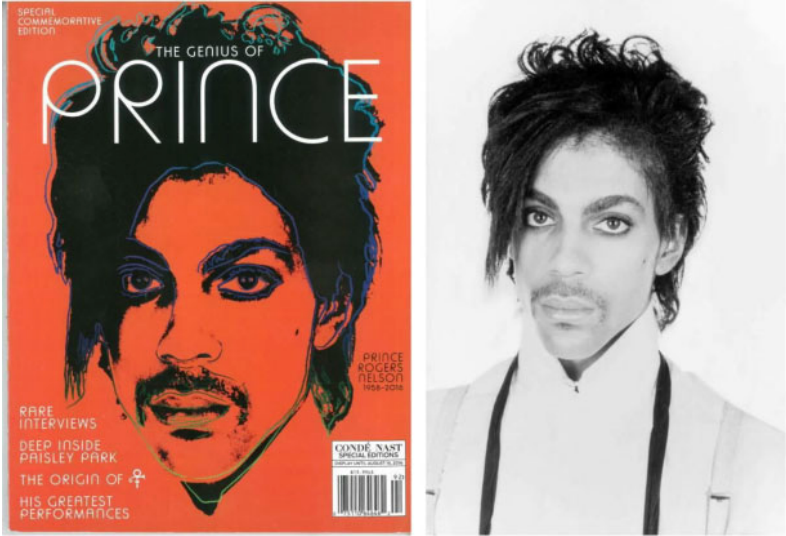
Many of you are already familiar with what happened next as the case wound through the Supreme Court. In an exceedingly unusual turn of events (masterfully recounted by Prof. Samuelson), the U.S. Solicitor General recast the question before the Court. It substituted a markedly different issue for the one actually presented to the Court:
Whether petitioner established that its licensing of the silkscreen image was a “transformative” use, and that Section 107(1) therefore weighs in petitioner’s favor, simply by showing that the image can reasonably be perceived to convey a meaning or message different from that of respondent’s original photograph.
This led the Supreme Court to ultimately decide an issue that it neither intended to review nor was fully briefed on, and resulted in a narrow holding focused solely on the non-transformative character of AWF’s licensing practice. None of the copyright nerds I know—who were so excited the Court was going to hear this case—welcomed the Warhol decision.
III. Warhol (What is it good for? Absolutely nothing)
The onslaught of criticism ranged from how a prima facie case for copyright infringement was never established before the Court examined a defense for infringement, how the case narrowly focused on one out of four fair use factors, how the Court invented a new doctrine that a transformative work created under fair use may nevertheless not be commercialized under fair use, how the court so broadly construed a “shared purpose” of licensing to magazines despite also acknowledging that no magazine commemorating Prince licensed images in the lackluster back-and-white style of Goldsmith, to how fair use is not even possible to raise as a defense to licensing, etc.
Maybe Warhol can never be criticized enough. But for our Fair Use Week celebration, let’s turn our attention to Warhol’s actual impact in lower courts. Did the dozen circuit court fair use cases post-Warhol follow the Supreme Court’s bid to interpret its Warhol holding narrowly, within the confines of licensing?
Or is the Warhol decision significantly changing how circuit courts analyze the First Factor under fair use?
IV. The twelve appellate opinions post-Warhol
Let’s take a look at how the circuit courts have applied Warhol in their First Factor analyses and whether any patterns have emerged now that nearly three years have passed. We identified twelve circuit court opinions that substantively analyzed fair use post-Warhol. Of those twelve, three were issued as summary orders or unpublished decisions (and thus lack precedential value), and one was later vacated. The twelve cases are as follows:
ASTM v. Public.Resource.Org (D.C. Cir. Sep 12, 2023)
Philpot v. Indep. J. Review (4th Cir. Feb 6. 2024)
Whyte Monkee v. Netflix (10th Cir. Mar 27. 2024) vacated
Griner v. King, (8th Cir. Jun 7. 2024)
Hachette v. Internet Archive, 115 F. 4th 163 (2d Cir. Sep 4. 2024)
Keck v. Mix Creative Learning Ctr. (5th Cir. Sep 18. 2024)
Designworks Homes v. Columbia House of Brokers Realty (8th Cir. Jan 14. 2025)
Teradyne, Inc. v. Astronics Test System (9th Cir. Jan 30. 2025) unpublished
Wilder v. Hoiland (2d Cir. Mar. 12, 2025) summary order
Romanova v. Amilus (2nd Cir. May 23. 2025)
Santos v. Kimmel (2d Cir. Sept 15, 2025)
Sedlik v. KVD (9th Cir. Jan 2. 2026) unpublished
One unsettling fact is immediately salient when you go through these opinions: Not all courts were able to accurately describe the holding of Warhol. The Supreme Court explicitly stated its narrow holding in Warhol is “AWF’s use of Goldsmith’s photograph in commercially licensing Orange Prince to Condé Nast does not favor AWF’s fair use defense.” Out of the four courts attempting to describe the holding of Warhol, only Keck and Romanova succeeded. Philpot alternatingly described the infringing use at issue in Warhol as the creation of Orange Prince or the use of the image as a magazine cover by Conde Nast. Whyte Monkee—now vacated—similarly described the infringing use as Warhol’s creation of the Orange Prince silkscreen. We don’t actually know how many lower courts are in camp Keck-Romanova versus camp Philpot-Whyte Monkee. But maybe we can glean the impact of Warhol by looking at how Warhol is cited in these appellate opinions.
V. Campbell by another name: “transformativeness” still rules them all
Transformativeness of a use has been an important component to the First Factor analysis. The central role of transformativeness was cemented when the Supreme Court back in 1994 held Campbell’s parody version of a popular Roy Orbison song was a transformative fair use. Even more than that, by surveying fair use decisions from 1978 to 2019, Prof. Beebe concluded that “a finding of transformativeness exerts by far the greatest impact of any finding on a court’s likelihood of making an overall determination of fair use.”
Given its central role, it may not be surprising, then, that the most popular use of Warhol has been in relation to transformativeness. Five out of the twelve appellate opinions cited Warhol in order to define “transformative use” as “a use that has a further purpose or different character.” This is of course lifted directly from Campbell (1994). Three courts instead cited Campbell directly for this definition. Three courts did not define transformativeness but nevertheless utilized the concept. One court did not mention transformativeness in its First Factor analysis (but did ultimately hold the use was fair).
More interestingly, we see that Prof. Beebe’s conclusion remains true post-Warhol: transformativeness correlates perfectly with an ultimate finding of fair use. Six out of the twelve cases found the use at issue was transformative, all of these transformative uses were held to be fair use. Five out of the twelve cases found the use at issue was not transformative, all of these were held to be infringing. The prediction that Warhol meant going forward “transformative use alone is not dispositive of a fair use finding” is quickly proving to be false.
Related to transformativenss, a third of the cases we looked at cited Warhol to support some variant of the proposition that, under the First Factor, the “‘central’ question” is “whether the use ‘merely supersedes the objects of the original creation . . . (supplanting the original), or instead adds something new, with a further purpose or different character.’” This, of course, is also a quote lifted from Campbell (1994), which has its origin in Justice Story’s 1841 opinion in Folsom v. Marsh:
The question, then, is, whether this is a justifiable use of the original materials, such as the law recognizes as no infringement of the copyright of the plaintiffs. [...] In short, we must often, in deciding questions of this sort, look to the nature and objects of the selections made, the quantity and value of the materials used, and the degree in which the use may prejudice the sale, or diminish the profits, or supersede the objects, of the original work.
A third of the circuit courts cited Warhol for the proposition that a further purpose—or transformativeness—is a matter of degree. But this idea is hardly new. It appears in Campbell (1994) where the Court framed the First Factor inquiry as asking “whether and to what extent [the defendant’s use] is ‘transformative’.” Equally popular from Warhol was the idea that commerciality weighs against the degree to which a use is transformative. You guessed it, it can be found in Campbell (1994)—and several courts did directly cite Campbell for the inverse relationship between transformativeness and commerciality in how they influence the First Factor.
So did Warhol add anything new for the circuit courts? Or can courts get away with simply citing Campbell (1994)?
VI. Dicta that never quite caught on
Despite its narrow holding, Warhol had several very confusingly bizarre dicta. Warhol pointed to two works sharing the same purpose as being “substitutive” under the First Factor. The concept of substitution is nothing new; Campbell also talked about how it weighs against fair use when a later work can substitute for the earlier work. But the important distinction is that under Campbell, substitution is to be considered under the fourth factor, because it has the natural meaning of one work substituting another in the market.
The appellate opinions from 2024 quoted this Warhol’s dicta without much scrutiny. Keck quoted Warhol to say the First Factor “‘relates to the problem of substitution—copyright’s bête noire.’ A use that has a purpose or character similar to that of the original copyrighted work is more likely to serve as a substitute for the original; the same is not true of a use that has a further purpose or different character.” Similarly, Hachette quoted Warhol to say “The use of a work to achieve ‘a purpose that is the same as, or highly similar to, that of the original’ is more likely to substitute or supplant the original work, and less likely to be considered transformative,” and proceeded to find, under the First Factor, that the Internet Archive “is meant to―and does―substitute for the original Works.”
Fast forward to 2025, Romanova tried to reign in the confusing dicta under existing fair use jurisprudence: though the 2nd Circuit Court agreed that “substitution” is important to consider as Warhol suggested, it emphasized that “The four statutory fair use factors should not be viewed as discrete questions, isolated from one another, but as interrelated issues contributing to a holistic inquiry.” Of course, this is nothing controversial, as quoted by Griner, even Warhol itself stated that “[T]he four statutory fair use factors may not ‘be treated in isolation, one from another. All are to be explored, and the results weighed together, in light of the purposes of copyright.’”
Out of the twelve opinions we looked at, only four opinions went beyond using Warhol simply to reiterate well-established principles under the First Factor, as described above. It may be too early yet to definitively call it a trend, but three out of these four opinions appeared in the first 13 months after Warhol was published, and only one, Romanova, in the last 20 months—and that one only engaged with Warhol in order to improve its clarity. In other words, in the last 20 months, not a single appellate court has cited Warhol in reliance of one of its problematic dicta. (Knock on wood!🪵) It seems appellate courts are following the Supreme Court’s bidding to construe the holding narrowly.
VII. All’s well that ends well
Overall, it seems scholars greatly exaggerated the impact Warhol would have on fair use. Some scholars believed that a secondary use “targeting” the original work will be essential under Warhol (that the secondary use must comment, criticize, or otherwise “target” some creative aspect of the original). Out of the twelve appellate opinions, only Whyte Monkee so held, but that opinion was quickly vacated. Even the concept of “justification” appears to be falling out of favor; other than an attempt by Romanova to broaden what counts as “justification” that would weigh in favor of fair use, all discussions about justification by appellate courts happened in the first 13 months after Warhol was published. In other words, in the last 20 months, no appellate court held the lack of justification against a would-be fair use. Even if justification or targeting was weaponized again to constrain fair use, at least now we have both Romanova and the article Romanova cited to defend a variety of beneficial cultural activities as fair use.
The tradition of fair use seems too strong to be undone, or seriously confused, by a single case. The circuit courts’ response to Warhol should leave us reassured of the resilience of fair use in this country. After all, as the Warhol Court eloquently stated, our copyright law “permits courts to avoid rigid application of the copyright statute when, on occasion, it would stifle the very creativity which that law is designed to foster.” Warhol, 598 U.S. at 527. Fair use seems to be alive and well post-Warhol. This is worth some celebration, this week—and beyond.
Discover more from Authors Alliance
Subscribe to get the latest posts sent to your email.
As one who testified on behalf of the Association of American University Presses at a hearing on fair use on July 31, 1973, before the Subcommittee on Patents, Trademarks, and Copyright chaired by Senator John McClellan, I have to say that the SCOTUS decision in Warhol conformed to what we in the AAUP recommended to Congress at the hearing with regard to the way Section 107 was then being drafted by the legislature. We urged Congress to make the fourth factor the preeminent factor, with the other three to be considered as subservient and secondary to it. This seems to be how the Court viewed the issues in the Warhol case, making the ,licensing issue paramount.
One might note that Warhol is a less clear-cut case of transformativeness than Cambpell because 2 Live Crew’s market is more clearly distinct from Roy Orbison’s and its creative appeal accordingly different whereas both the Prince photograph and the Warhol derivative are in many ways duplicative with respect to the market they both appeal to. In other words, Warhol’s work can be more readily seen as s substitute than 2 Live Crew’s dong can be seen as a substitute for Roy Orbison’s song.
It will be interesting to see how SCOTUS applies both Campbell and Warhol to the inevitable AI cases that are wending their way to a showdown there.
Pingback: A Comprehensive Review of Post-Warhol Appellate Decisions on the First Factor | Fair Use/Fair Dealing Week