
Check out our series of posts marking the 50th anniversary of the Copyright Act of 1976, as well as a variety of other Fair Use Week blogs and events around the country.
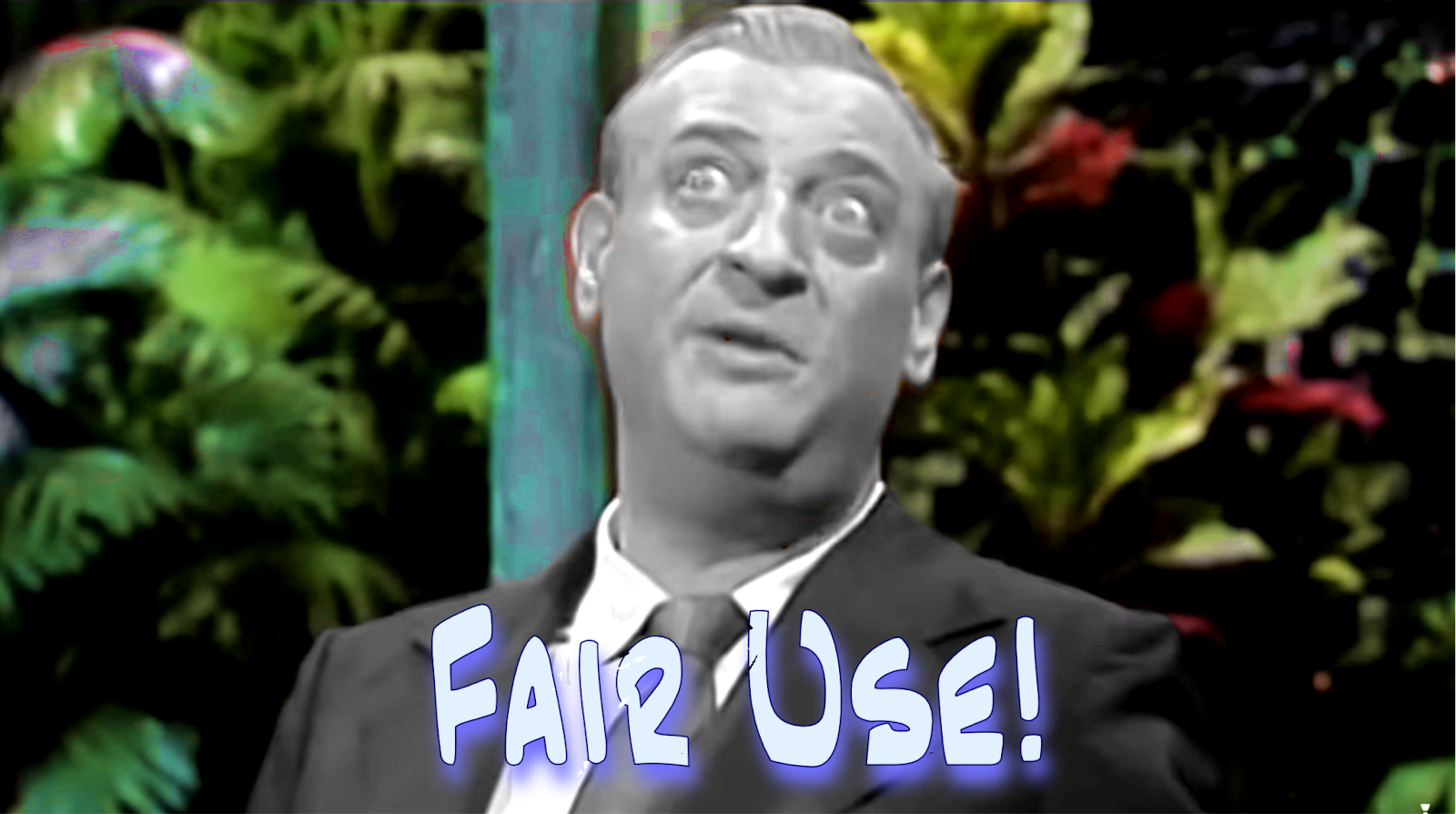
Like Rodney Dangerfield, the second factor gets no respect. It deserves better.
Everyone loves an underdog, and one of my favourites is the second fair use factor—“The nature of the copyrighted work.” The Second Circuit’s Judge Pierre Leval, in Authors Guild v. Google, neatly summed up the view of nearly every court that has taken up a fair use question: “The second factor has rarely played a significant role in the determination of a fair use dispute.” At best, most fair use opinions devote no more than a couple of paragraphs to the second factor.
I’m imagining a personified second factor, sitting on a bar stool in front of a stand-up mic: “I tell ya, I don’t get no respect. A judge tried to write about me and even he ran out of things to say.” (don’t worry, I’m not quitting my day job).
Judge Leval, to be fair, devoted several pages to the second factor in his highly influential article, “Toward A Fair Use Standard.” In addition to giving us the “transformative use” theory of the first factor, Judge Leval’s article gave us the principle question courts ask in analysing the second factor: “whether the work is the type of material that copyright was designed to stimulate.” But even then, the article spends most of its time questioning whether the Supreme Court, in Harper & Row v. Nation Enterprises, had given the publication status of the work too much weight (conclusion: it had). In most courts’ fair use opinions, the “nature of the copyrighted work” has been reduced to two questions: “is it primarily factual or creative?,” and “is it published or unpublished?”
Think about that for a moment: the nature of a work has been reduced to two binary, rather forumulaic questions. In FY2024, the Copyright Office registered around 425,000 works, representing an important and representative slice of the year’s creativity. What is the “nature” of those works? As far as the courts seem concerned, each is easily sortable on a 2 by 2 grid.
When I was in library school, my classes spent much of their time wrestling with “works” and what they are—their nature. I remember a couple of excellent (and, for me, mind-blowing) papers by Jerrold Levinson asking “what a musical work is.” Richard Smiraglia’s book, “The Nature of a Work,” is a genuine classic in the field. Determining the nature of a work is a philosophical problem—a branch of applied ontology—that we certainly weren’t able to solve in my three years of graduate study. Surely, from a legal standpoint, it is more than just two on/off switches.
It is a little surprising to me that more authors don’t object more strongly to the gross oversimplification of what is sometimes their life’s work.
Almost twenty years ago, now recently-retired Associate Register of Copyrights Rob Kasunic proposed, in this article, that everyone was missing the point of the second factor. He showed how some of the most important thinkers on the topic of fair use, including Judge Leval and Justice David Souter (a personal hero of mine), had misinterpreted the doctrine’s origins, and that even Judge Story, in Folsom v. Marsh, had misinterpreted the doctrine. I love this aside in Kasunic’s article:
“We must keep in mind that the originator of a doctrine is just as susceptible to inadequate analysis as those that follow.”
And Kasunic illustrates the point by showing how Judge Leval, too, did not fully complete the important work of one of his own observations. “Whether the work is the type of material that copyright was designed to stimulate,” Kasunic argues, is not simply a question of whether a work is published or unpublished, nor is it a question of value. Each of the four factors is tied to the purpose of copyright itself, but the purpose of copyright does not reflect a preference for unpublished—or for fictional—work.
Copyright exists to promote authorship, not commercial return. But, as Kasunic argues, the incentive to create is not necessarily the same as the incentive to market. The incentive to write a letter or to record the minutes of a business meeting is not the same as the incentive to create a blockbuster movie or a mystery novel. And, importantly, the different incentives—such as the creative incentive and the commercial incentive—are not necessarily motivational to the same parties. Academic articles, for example, can be very profitable, but the academic authors that write them are not motivated by (nor do they see any of) that profit.
One thing I find especially compelling about Kasunic’s article is his argument that the second and fourth factors are aimed at different parts of the copyright incentive, and that the second factor should consider the author’s motivation. If, when they created the work, the author was reasonably expecting little or no economic benefit, then that should be considered by the court. If the author would reasonably expect (or hope for) the work to be shared widely, the court should also take that into account.
The legislative history suggests Congress had a dual purpose in enacting the fair use statute. The first was to ensure that the doctrine survived, and the second was to make the doctrine somewhat more predictable. The list of factors was aimed at the latter, by providing guidance in the factors courts should consider. Prior to the enactment of the 1976 Act, there was no standardized list of factors developed by the courts. The Copyright Office’s definition, in its 1961 report, arguably only includes two factors—a reasonable portion of the work and non-competition with the original. Folsom had at most three. By contrast, Saul Cohen’s restatement of the law identified as many as eight factors:
- The type of use involved;
- The intent with which [the use] was made;
- Its effect on the original work;
- The amount of the user’s labor involved;
- The benefit gained by [the user];
- The nature of the works involved;
- The amount of material used; and
- [The copyrighted work’s] relative value.
(from Fair Use in the Law of Copyright, 1953)
But Cohen’s list of factors also provides a foil for the first purpose of codification—to do neither more nor less than preserve the common law fair use tradition as it was continuing to evolve. The Copyright Office’s 1954 study on fair use, the comments on that report, the register’s 1961 report, and the House Report all point to a desire, on the part of everyone involved, to allow the courts to continue developing the doctrine unhindered. The legislative history is clear on this one truth—that Congress was trying to preserve a living common law doctrine.
Rather than fixing a test, Congress listed four factors as a guide. The law is explicit on this point—Section 107 states that “In determining whether the use made of a work in any particular case is a fair use the factors to be considered shall include [the four factors].” (emphasis added). Under the definition provided in Sec. 101, the word, “include,” is to be interpreted as, “illustrative and not limitative.” But despite the very clear instruction of Congress that courts should continue to develop fair use jurisprudence, courts have instead almost universally limited their analysis of fair use to the four statutory factors. In addition, courts have mostly declined to exercise independent judgment in developing those factors.
The biggest loser (aside from potential defendants) has been the second factor.
For a court system that is increasingly textualist in its application of statutes, this is surprising to me. The plain meaning of the statute gives courts room to continue to develop their common law, and the legislative history supports that interpretation. Yet, the courts have instead read a prescriptive, static doctrine. A non-limitative list of four factors that normally would be considered equitably has become a “four-factor test,” where courts mechanically look at each factor in turn and determine whether it “weighs” in favour or against fair use—just another set of light switches. Kasunic (and many others that cited to his article) hoped courts would rethink the process:
“Properly performed, the proposed analysis of the second factor will not ‘weigh’ in either party’s favor, and hopefully courts will realize that factors have no weight in isolation.”
That has not come to pass, but I would love to see courts rethink how they treat at least the second factor. Congress did not freeze fair use in 1976, they preserved it. They instructed courts to be creative and equitable, and to consider all of the facts together including the four factors. Despite paying lip service to the possible of existence of more factors, the courts have treated the statutory factors as an exclusive list, preventing the doctrine from reaching its full potential.
One day, perhaps, courts will treat the nature of works as a complex question. In the meantime, the second factor will keep waiting for respect.
Discover more from Authors Alliance
Subscribe to get the latest posts sent to your email.
Pingback: Respecting the Second Factor | Fair Use/Fair Dealing Week