
This is the latest in our series of posts marking the 50th anniversary of the Copyright Act of 1976. To find a list of all the posts in this series, click here.
As anyone who has ever lived in an old house knows, sometimes additions and renovations are great. Sometimes they are good ideas but poorly executed. And sometimes they are just bad ideas from the start. That last category is where I’d put 104A.
Section 104A is responsible for one of the greatest contractions of the public domain in history. It’s the first provision we’ve covered in this series that wasn’t part of the original 1976 Act — it was a later addition that fundamentally changed the landscape of what works could be freely used in the United States. Section 104A was first added to Title 17 in December of 1993 as part of a series of changes related to the North American Free Trade Agreement (originally covering only motion pictures produced in NAFTA countries). But Section 104A is best known for its later amendments, which implemented the Uruguay Round Agreement (which also led to the creation of the WTO) through the Uruguay Round Agreements Act. The very short version of 104A’s function is that it expanded — I refuse to say “restored” — copyright protection to innumerable foreign works from all around the world that were already in the public domain in the United States.
Copyright Formalities
To understand what Section 104A does and why it was enacted, we have to take a short diversion into something known as “copyright formalities.” As recounted earlier in this series, copyright in a work created today happens through a certain degree of legislative magic: as soon as an original work of authorship is fixed in a tangible medium of expression, 💨poof!💨, it has copyright. But it wasn’t always that way.
Up until the late 1980s, Congress had always required you to do something — albeit not much of a “something,” but still something — to obtain and maintain protection. We call these somethings formalities. They have historically been very low bars to protection, but they were still a meaningful way to communicate with the public about who owns what. The most important formalities were the requirement of adequate notice (such as putting a © symbol and the year on your work), and the renewal requirement (filing again after 28 years to extend your term). If you didn’t comply with these requirements, your work entered the public domain immediately upon publication. For some of the most helpful thinking on this subject, I encourage you to read the pieces in this Berkeley Technology Law Journal issue on copyright formalities, especially the piece by Stef Van Gompel.
What 104A Does
When the United States joined the Berne Convention for the Protection of Literary and Artistic Works in 1989, it signed onto a treaty that generally prohibits member countries from requiring formalities as a condition of copyright protection.
Other countries had long operated without these requirements, and by joining Berne, the US had to change its law to comply. But one of the results of the previous mismatch between formality-free copyright outside the US and formality requirements inside the US was that many foreign works had technically entered the U.S. public domain because their creators–who were primarily concerned with copyright in their home country– hadn’t complied with U.S. rules.
Congress very slowly started to address this mismatch, with increasing pressure from other treaty parties. Section 104A was Congress’s answer. Under the statute, copyright protection was automatically extended to foreign works from Berne member countries that were in the U.S. public domain solely due to noncompliance with those formalities — primarily failure to affix notice and failure to renew. Overnight, works that libraries had microfilmed and even digitized, that publishers had reprinted, that musicians had performed and recorded, and that filmmakers had incorporated into new productions, became copyrighted. The owners of these newly-created copyrights could send what the statute calls “notices of intent to enforce” — essentially, letters informing users that (at least from their perspective) the free ride was over.
Likely hundreds of thousands of works — foreign films, musical compositions, books, and other creative works — had their public domain status revoked. Users who had built businesses, projects, or collections around those works found themselves suddenly liable for infringement. The law included some procedural protections for those “reliance parties” but they were a far cry from the freedom those creators and users previously enjoyed.
The justification was reciprocity: the U.S. wanted other countries to protect American works abroad, and extending the same courtesy to foreign works here was the price of that deal. What this obscures is that the people who actually bore the costs — educators, libraries, publishers, archivists, and members of the public who had relied on the public domain status of these works — had no seat at the table. The Uruguay Round was crafted in trade negotiations, not copyright policy hearings. And in reality, copyright was just a tiny piece of these trade negotiations, and perhaps one area for which the broad public repercussions were underappreciated.
A Bad Fit for Copyright’s Purpose
Copyright law in the United States is built on a utilitarian incentive theory: we grant creators a limited monopoly to encourage the creation and distribution of new works, and when that term expires, the works return to the public. The public domain isn’t a bug in this system; it’s the point. Works enter the public domain because society’s bargain with the author has been fulfilled.
Section 104A broke this logic entirely. The foreign works swept back under copyright in 1994 had already been created. Their authors were not waiting for U.S. copyright protection before putting pen to paper — many were long dead. Extending copyright to these works did nothing to incentivize their creation, because they already existed. It simply transferred value from users who had relied on public domain status to copyright holders, with no corresponding public benefit—what could very justifiably be termed economic rent seeking. Whatever justification 104A has, it isn’t a copyright justification. It’s a trade justification wearing copyright’s clothes.
Golan v. Holder and the Failed Challenge to Restoration
Unsurprisingly, people who had built their livelihoods around works that 104A yanked back into copyright fought back in court. In Golan v. Holder, a group of orchestra conductors, musicians, and publishers challenged the Uruguay Round Restoration Act, arguing that Congress lacked the authority to remove works from the public domain once they’d entered it. The case made its way to the Supreme Court, which ruled against the challengers 6–2 in 2012 (Justice Kagan did not take part in deciding the case).
Justice Ginsburg, writing for the majority, was largely untroubled by the public domain problem. The Copyright Clause’s text, she reasoned, doesn’t categorically prohibit Congress from withdrawing works from the public domain, and Congress had extended copyright protections to previously unprotected works before (and in some ways, here Congress was not “extending” term but granting a term for the first time to at least some of these works). On the treaty compliance rationale, she was deferential: given Congress’s authority, the Court would not second-guess the political choice Congress made between leaving the public domain untouched and embracing Berne unstintingly. In other words: this is a policy call, not our business.
Justice Breyer’s dissent, joined by Justice Alito, was considerably more pointed. Breyer grounded his objection in copyright’s core purpose — the incentive to create — and found restoration wanting by that measure. The statute, he wrote, “does not encourage anyone to produce a single new work. By definition, it bestows monetary rewards only on owners of old works — works that have already been created and already are in the American public domain.” Breyer also flagged the practical harm to users: restoration allowed copyright holders to impose fees on works that the public had previously used freely, and raised the administrative burden on potentially millions of works whose ownership was now uncertain. He concluded that the government hadn’t even used the least restrictive methods of Berne compliance available to it. The dissent reads, in retrospect, as a fairly clean articulation of everything wrong with 104A — which makes the 6–2 outcome all the more frustrating for those of us who think the public domain deserves a more vigorous judicial defense.
A Subatomic Public Domain
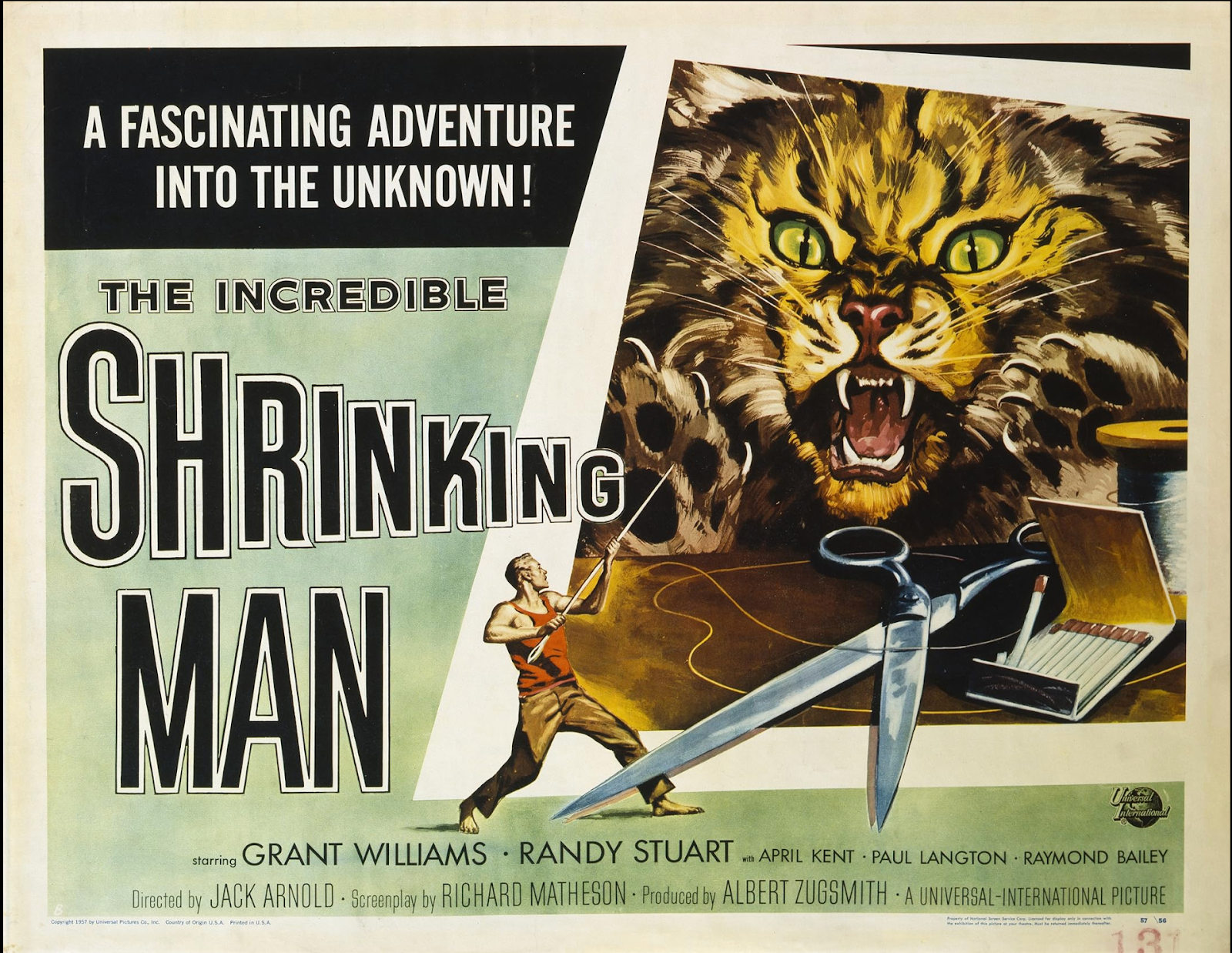
For anyone who has seen The Incredible Shrinking Man or read the Richard Matheson novel on which it is based, you know the ending is the saddest part. The short version for anyone who hasn’t read it (not sure if I need a spoiler warning on a 67-year-old book): A man named Scott Carey is on vacation when he is exposed to a radioactive cloud. Six months later, he notices his clothes are too big. As time progresses, Carey becomes a national sensation, but no one can do anything about his shrinking. Eventually, he finds himself alone in his basement, pondering the nature of his very existence. Carey makes peace with his fate by embracing a kind of cosmic consolation: matter cannot be destroyed, and so he must persist, even as he shrinks toward the subatomic. He will become part of the universe. He takes comfort in the idea that no matter how small he becomes, he will still, in some meaningful sense, exist.
Unlike Scott Carey, Congress did not wander into a cosmic stew of radiation. 104A is the product of trade negotiations conducted by specific actors serving specific interests, with the costs borne by people who weren’t in the room. Carey’s consolation is that he will always exist at some undetectable scale. That’s a fine philosophy for a fictional man. A public domain that technically exists but is practically inaccessible isn’t meaningfully different from one that doesn’t exist at all.
The Incredible Shrinking Public Domain has another sometimes overlooked feature—that as it shrinks, it just gets harder to see. Figuring out what is actually in the public domain, as a result of 104A, is incredibly difficult. A quick peek at Peter Hirtle’s famous (well, famous in my circles) public domain chart reveals the complexity, requiring one to interrogate all sorts of messy questions about when a work was protected in its home country, how it was published, and numerous other questions.
I am grateful that the changes we saw primarily in the 1990s to shrink the public domain through 104A, copyright term extension, and elimination of the last formalities for domestic works has not become a trend in US law. Congress has not, for instance, taken up term extension again after its tacking on an extra 20 years in 1998. And so the public domain has reversed course – it’s not becoming infinitesimally small as some of us once worried it would become, and now it is actually growing, slowly. In this way, the end of the 104A story is not great, but also not quite so sad as The Incredible Shrinking Man.
Discover more from Authors Alliance
Subscribe to get the latest posts sent to your email.