
This is the latest in our series of posts marking the 50th anniversary of the Copyright Act of 1976. To find a list of all the posts in this series, click here.
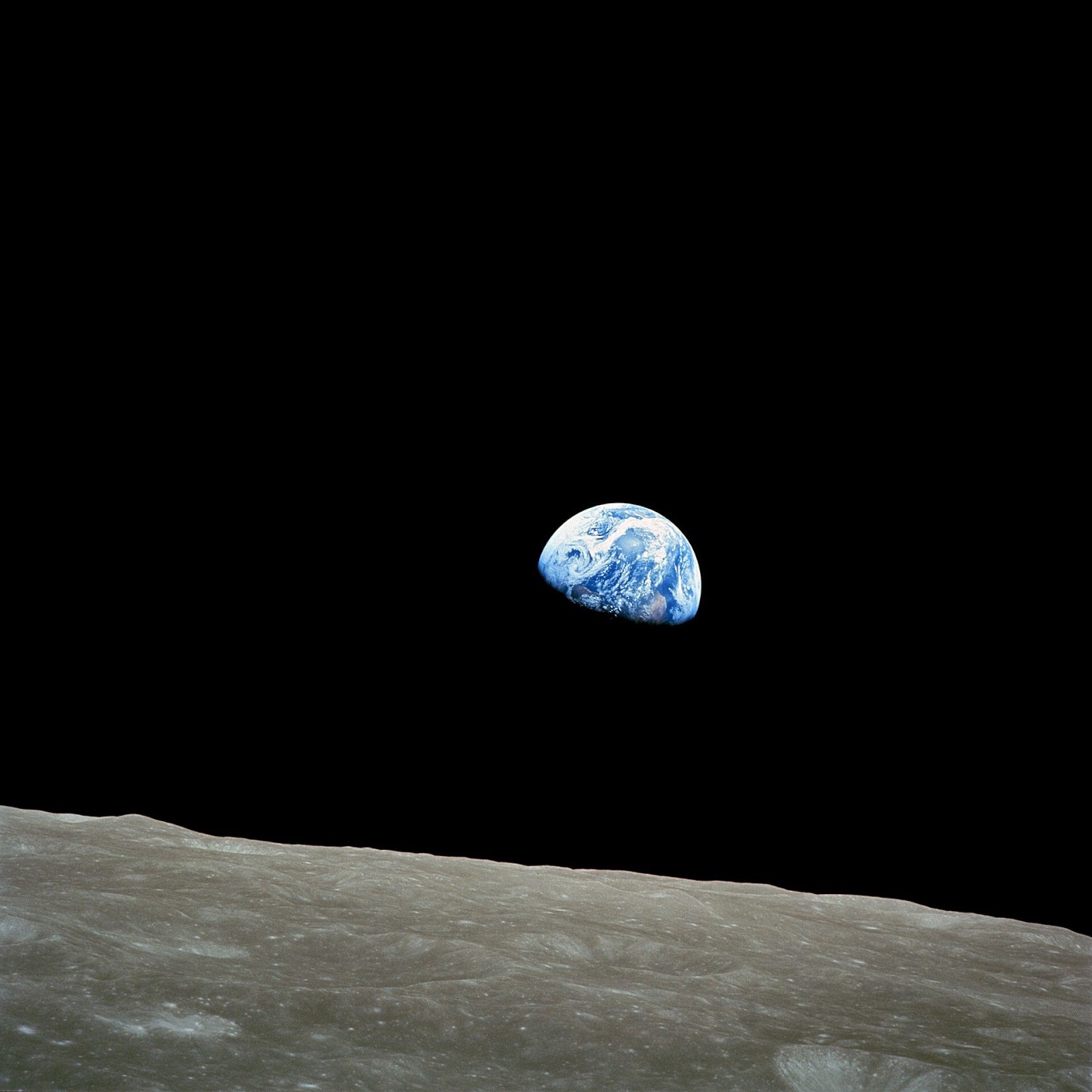
Some years ago I played a series of performances of Kile Smith’s The Consolation of Apollo, a marvelous and imaginative piece of music for mixed chorus and percussion. The words are largely those of astronauts Frank Borman, Jim Lovell, and William Anders, taking in the sight of the earth rising as they completed the first human orbit of the moon. The photograph Anders took in that moment is one of the most famous and consequential in the history photography, and it is used by Smith to promote the work. The Apollo 8 mission took place in 1968, and yet neither the photograph nor the words of the astronauts required the composer to secure any copyright permission. The reason is Section 105.
Section 105 was originally one of shortest single sections in the original Copyright Act (there was some competition for the shortest, but the winner, at 24 words, was and remains Sec. 305). It consisted entirely of the following single sentence:
“Copyright protection under this title is not available for any work of the United States Government, but the United States Government is not precluded from receiving and holding copyrights transferred to it by assignment, bequest, or otherwise.”
Simply put, no work authored by the U.S. Government is subject to U.S. copyright. If a work is “prepared by an officer or employee of the United States Government as part of that person’s official duties,” then it is immediately and irrevocably in the public domain in the United States. (Sec. 105 was amended in 2019 to allow the Secretary of Defense to exempt faculty at service academies from this rule. It is no longer anywhere close to being the shortest section).
The United States’s position on the copyright status of the works it creates is unique in the world. Though most countries have some kind of public access carveout (especially for things like laws and judicial opinions), every other country—that I’ve found at least—nonetheless claims some form of copyright over its government’s works. This surely makes the United States Government the world’s largest publisher of public domain material.
The rule that U.S government works are in the public domain was not groundbreaking in the 1976 Act. The United States’s common law tradition of requiring free use of government works traces back at least to a line of cases starting with Wheaton v. Peters, where the Supreme Court (in its very first copyright case!) was unanimously of the opinion that no one could hold copyright in the Court’s own opinions. The Copyright Office’s report traces the statutory history to the 1895 act “for the public printing and binding and the distribution of public documents.” Sec. 52 of that act authorized the Government Printing Office to sell printing plates used to create government documents (in order to encourage private re-printing), but with the proviso that none of the copies printed could be given copyright.
The 1909 Copyright Act incorporated the Printing Act’s principle into the copyright laws—not only could no claim copyright on government publication simply as a condition of sale of the plates, there could now be no such copyright in the first place. Section 7 of the 1909 Act led with a principle that is no less true now, but perhaps surprisingly is no longer explicitly stated: that “no copyright shall subsist in the original text of any work which is in the public domain.” Almost as an aside, Sec. 7 (later renumbered as Sec. 8) made clear what the Printing Act had strongly implied: that no government publication could hold copyright, except that copyrighted works published by the government were still the property of their respective owners.
Though the federal government had developed a strong tradition of exempting its works from copyright, the state governments all claimed copyright over theirs. Why were states permitted and not the federal government? Because printing was expensive, and some states wanted private companies to print their laws for them. If you’re a state like, say, Oregon, and you also don’t want to pay the private companies to print the laws, you need to offer them something to justify their risk and expense. That’s where copyright comes in.
I’m picking on Oregon, partly because it’s where I went to law school, but mainly because the state famously tried to enforce their copyright claims against two of my favourite websites: Justia and Public.Resource.Org (under public pressure, the state eventually backed off). But though Oregon may be the most notorious example, it is not the only state that is a potential copyright plaintiff—every state claims copyright protection over works that, had they been created by the federal government, would be in the public domain under Sec. 105.
Several years after the Oregon incident, the state of Georgia tried to enforce copyright over its annotated code, and the Supreme Court ruled that it could not. The Court’s reasoning is an interesting bit of what I think is judicial sleight of hand.
The problem starts in the nature of copyright authorship. Under the 1976 Act, authors are the original owners of their copyrighted works. In the case of laws, judges and legislators write the law, and so normally this would make them its copyright owners. But allowing judges and legislators copyright when they’re acting in their official capacity would create an undesirable result: it would give lawmakers a monopoly over the laws that bind the people. This was contrary to the principle, known as the Government Edicts Doctrine, that no person can own the law.
To solve the dilemma, the Court created a judicial limitation on the eligibility of authorship. Beginning with Wheaton, the Court had already determined that judges were not eligible to be authors for copyright purposes; in Georgia, they extended that restriction to legislators. The Court reasoned that, since legislators and judges cannot be authors of the law, it followed that laws in fact have no author at all, at least for copyright purposes. Since copyright requires authorship, there could be no copyright in laws.
I think the Court missed an important step in their logic. The Court followed their precedent in holding that judges and legislators can’t be authors of the laws they create while exercising sovereign authority. So far so good. But the Court’ didn’t complete the analysis—they eliminated the possibility that the individuals were authors, but not the possibility that the state was the author.
As Justice Thomas noted in his dissent, when the Court decided the Wheaton line of cases, copyright was offered only to “citizens of the United States or residents therein.” States were neither citizens nor residents, and so could not be “authors.” But the law has since changed to include corporate authors in their role as employer. As we’ll discuss when we get to Chapter 2 (and as I wrote about extensively in this white paper), people who perform work within the scope of their employment generally aren’t themselves the authors of the works—their employers are. The Majority opinion didn’t address the possibility that the laws of a state are works made for hire.
The court ruled that legislators were as subject to the Government Edicts Doctrine as judges were, but it never asked (or answered) the more important question—whether the state itself was.
I think the Court got to the right end result in Georgia—laws should not be subject to copyright for many reasons. But the Court had a more elegant—and legally consistent—option available to it: the Court could have determined that laws are works made for hire (because, after all, they clearly are), and then followed the chain of employment to its logical conclusion: judges and legislators are employees of the state, and the state is, in turn, employed by the public. This would have been a beautifully democratic finding.
If the majority in Georgia applied somewhat fuzzy logic, I very much doubt it was an accident. To begin with, the case presented a more complicated question than simply whether all laws are in the public domain. Everyone, including Justices Thomas and Ginsburg (in one of her final dissenting opinions), agreed with that premise. There were harder questions of whether private works could be pulled into the public domain by the Government Edicts Doctrine. There clearly was a needle to thread.
But I think more interestingly, had the Court completed its analysis and found that government works were made for hire, it would have been forced into a much more groundbreaking rule. If the work of the state is owned by the people as work made for hire, then all of the work of the state is owned by the people—not just the laws, but also reports, literary works, sound recordings, photographs, and even possibly academic research. The court understandably would have been reluctant to hand down an opinion that was so shattering to expectations. But I think it also would have been the proper decision. Taxpayers, after all, foot the entire bill for their government.
All this brings me back to Section 105, and Earthrise, the iconic photo of the moment that inspired the astronauts to inspire Kile Smith. Congress adopted a rule for itself that nothing its employees create in the scope of their employment—including laws but also including things like NASA-produced photographs—is copyrightable. Congress considered extending Sec. 105 to include state governments, but declined. I think that’s a pity, especially in light of the subsequent decline in publication costs in the internet era. Copyright is exclusively federal law, and Congress may choose not to extend it. If Congress doesn’t, the Courts have the doctrinal power to do so using only their established precedent.
Perhaps in a future law Congress will complete the work it began with Sec. 105. Then the U.S. government might have competition for the world’s largest public domain publisher.
Discover more from Authors Alliance
Subscribe to get the latest posts sent to your email.