
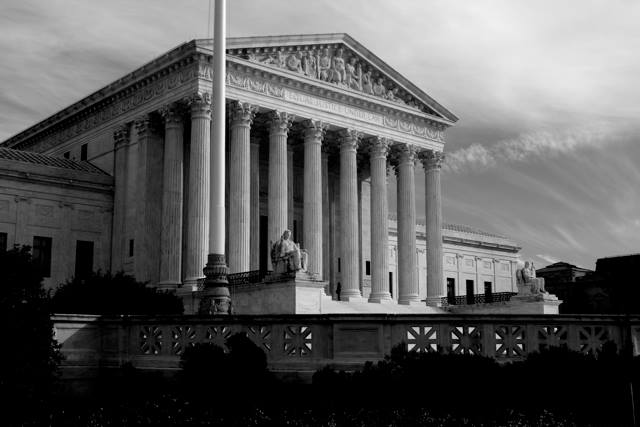
Yesterday, the Supreme Court delivered its ruling in its only copyright case for this term: Cox Communications v. Sony Music Entertainment. The court ruled that an internet service provider, Cox Communications, was not secondarily liable for acts of copyright infringement committed by its users. In the process, the Court froze a common law doctrine it had itself developed, possibly signaling trouble for future appeals to development of the common law of copyright.
Secondary liability for copyright infringement occurs when the defendant did not itself infringe a copyright—it did not actually do the thing that infringed the plaintiff’s copyright—but either it intended its service to cause infringement (called contributory infringement), or it benefited from the infringement in a way that causes liability to attach (vicarious infringement). This case involved contributory infringement.
The problem with secondary liability is that it doesn’t expressly appear in the copyright law. The closest it comes is in Sec. 106, where Congress gave authors exclusive rights “to do and to authorize” any of five things with respect to their work. That second part—the exclusive right to authorize actions—was, according to the House Report, supposed “to avoid any questions as to the liability of contributory infringers.”
But rather than avoiding any questions, the statute raised more questions. One such question is how secondary liability attaches. What actions do you have to take in order to be liable for someone else’s infringement?
The Supreme Court has addressed secondary liability twice in the years since the 1976 Copyright Act came into effect. In the first case, Sony got the win. In Sony v. Universal City Studios, the court found that Sony’s sale of video cassette recorders (VCRs) did not constitute contributory infringement. Sale of the VCRs could not have constituted the necessary intent to induce copyright infringement, the Court said, because VCRs had “substantial non-infringing uses”—they were not tailored for copyright infringement. In the second case, MGM Studios v. Grokster, the Court identified a second way of showing intent to infringe. The Court found that MGM could prove the necessary intent, despite Grokster’s file-sharing service having potentially non-infringing uses, because the company had induced infringement through things like advertisements promoting its infringing capabilities.
Though Sony and Grokster were the only cases in the Supreme Court, lower courts had adopted additional ways of proving intent. Most relevant to this case is the Fourth Circuit, which had found that “supplying a product with knowledge that the recipient will use it to infringe copyright” is sufficient to prove intent.
Sony was decided before the digital era began; Grokster was decided after. In between the two, Congress passed the Digital Millennium Copyright Act (DMCA), which, among other things created a “safe harbor” for internet service providers. Under Sec. 202 of the DMCA (codified in Sec. 512 of Title 17), if a “service provider” takes certain minimum steps to deter copyright infringement by its users, it would be immune from contributory liability. But Congress specified this was a minimum safe harbor, not a maximum. Service providers that did not follow the statutory requirements from the safe harbor were not necessarily liable, but they also weren’t necessarily protected. They were taking their chances with what the Courts found.
At trial, Cox was found liable for both contributory infringement and vicarious infringement, and in each case the jury determined the conduct was willful, a finding which unlocks significantly higher statutory damages. The jury imposed a fine of $1 Billion in statutory damages. The Fourth Circuit overturned the judgment of vicarious infringement, but upheld the finding of contributory infringement, remanding the case for reconsideration of the jury award. (For procedural reasons, Cox no longer had a Sec. 512 defense available).
With this ruling, the Supreme Court unanimously reversed the lower courts’ judgments on the question of Cox’s infringement, holding Cox was not liable at all.
In the process, by a 7–2 vote, the Court announced a new rule, or rather a new reformulation of its rule. Contributory liability can be found, the Court wrote,
“. . . only if [the defendant] intended that the provided service be used for infringement. The intent required for contributory liability can be shown only if the party induced the infringement or the provided service is tailored to that infringement.” (emphasis added).
Previously, the necessary intent could be proven in at least two ways: either (1) the service was tailored for infringement through the lack of substantial non-infringing uses (Sony), or (2) the service induced the infringement by actively encouraging infringement through specific acts (Grokster). Under Cox Communications, the rule is the same, except those are now the only ways intent can be proven. With yesterday’s ruling, the Court has closed the door to further development of its own precedent, at least in this area of copyright. The Court held that the Sony and Grokster tests were the beginning and end of the common law of contributory infringement.
Why this matters for authors
The Section 512 safe harbor provisions have been something of a mixed bag. They have in part allowed the fantastic growth of online services that have become central to life in a digital world—including ISPs, of course, but also including online research tools such as search engines; institutional research repositories; video and photo sharing platforms; social media; and even email services. But as with many safe harbors, Sec. 512 came with a catch: to take advantage of the safe harbor, an institution needed to comply with a fairly detailed set of rules—most notoriously the “notice and takedown” process—that has had well-documented chilling effects in numerous areas of the internet.
I have lost track of the number of times I have seen take down notices issued for materials that weren’t even close to infringing—things like public performances of public domain music where the performer just sounded a little too much like the recording she was influenced by. Take down notices also result in uses that are fair being taken down—not because they were infringing, but because it was safer to take them down than to let the user make that decision. Today’s ruling is unlikely to put a stop to overly-cautious take-downs, but it may at least embolden less-risk-averse services to take more chances on behalf of their users.
In copyright law, many safe harbors, including but not limited to Sec. 512, have provisions stating, essentially, that the safe harbor has no effect on other defenses under the normal laws. They do not dictate the outer boundary of what is permissible under the law—they simply offer a safe place to swim for the most risk averse. Today’s ruling provides much-needed reinvigoration of the very important principle that when Congress says “Other defenses are not affected,” the courts should take those words seriously.
In addition, the Court’s finding that there are only two ways to prove intent for contributory infringement may create a degree of certainty and uniformity that it had not provided in its earlier rulings. By holding that Sony and Grokster are the complete story in contributory infringement, online service providers will be better able to assess their risks when they decide whether or not to follow a course of action. They will also be assured that the law in this one question is the same in Virginia (where this suit was brought) as it is in Oregon, or Texas, or Michigan. Circuit courts are no longer free to develop additional forms of proof in contributory copyright cases.
But there is an important caveat, which is that though limiting the development of the common law here may have had a positive impact for service providers, there may be other areas where as yet undeveloped common law could help solve problems the statutes have so far been unable to address. These might include issues we have written about at some length, such as orphan works, contractual override of copyright, or faculty authorship of scholarship. The court’s slamming the door on common law development in this narrow instance means one might be cautious in asking the court for common law help in other areas of copyright.
Justice Sotomayor concurred in the judgment, but would have taken a narrower approach. In her concurrence (joined by Justice Jackson), she explained that Fourth Circuit’s rule was, essentially, the common law’s aiding and abetting form of contributory liability. She would have preserved that method of proving intent even while she rejected it as applied to Cox Communications. She argued that the Court, by closing down alternate forms of liability, was essentially rendering meaningless the Sec. 512 safe harbor—that service providers had no incentive to follow Sec. 512’s notice and take down system if they didn’t need the safe harbor in the first place. The concurrence points to an obvious downside of the Court’s opinion—that if you want to get your stuff taken down, it likely will become harder to do so.
Still, I think this is a positive ruling overall. As the Electronic Frontier Foundation and others argued in a supporting brief, “the record in this case shows many instances of alleged infringement associated with accounts for universities, hospitals, local government agencies, and, in the case of subcontracted services, entire municipalities. These institutions provide internet access to millions. The same holds true for school, academic, public, tribal and other types of libraries, where reliable internet access is a core service that these institutions provide their patrons and broader community.”
If you access the internet through one of these kinds of organizations, this case is a win for you.
Discover more from Authors Alliance
Subscribe to get the latest posts sent to your email.