

On August 27, 2026, the Fifth Circuit held that a news aggregator that frames headlines and sends readers back to the original publisher’s site does not itself publicly display those articles under the Copyright Act. The Fifth Circuit rejected the Ninth Circuit’s “server test,” which shields sites that embed or frame content hosted elsewhere from direct liability under the display right. But its reading of the statute leaves embedders in much the same position they were in under the server test.
To date, the Ninth Circuit is the only circuit that adopted the server test. Emmerich is the first appellate decision outside the Ninth Circuit to take display right claims involving online embedding head-on.
Online framing and embedding are central to how authors quote, cite, and build on each other’s writing. By making that practice harder to challenge as infringement, Emmerich promotes online expression and access to information core to the goal of the Copyright Act to promote development of arts and science. And for authors who want their work shared broadly online, the decision is a welcome step toward removing the legal risk that attaches to everyone who might embed it.
Plaintiff-appellant Emmerich Newspapers publishes more than two dozen local newspapers online. Emmerich sued Particle over its free local news website, NewsBreak, which frames Emmerich’s articles and links users back to Emmerich’s own site to read the full story.
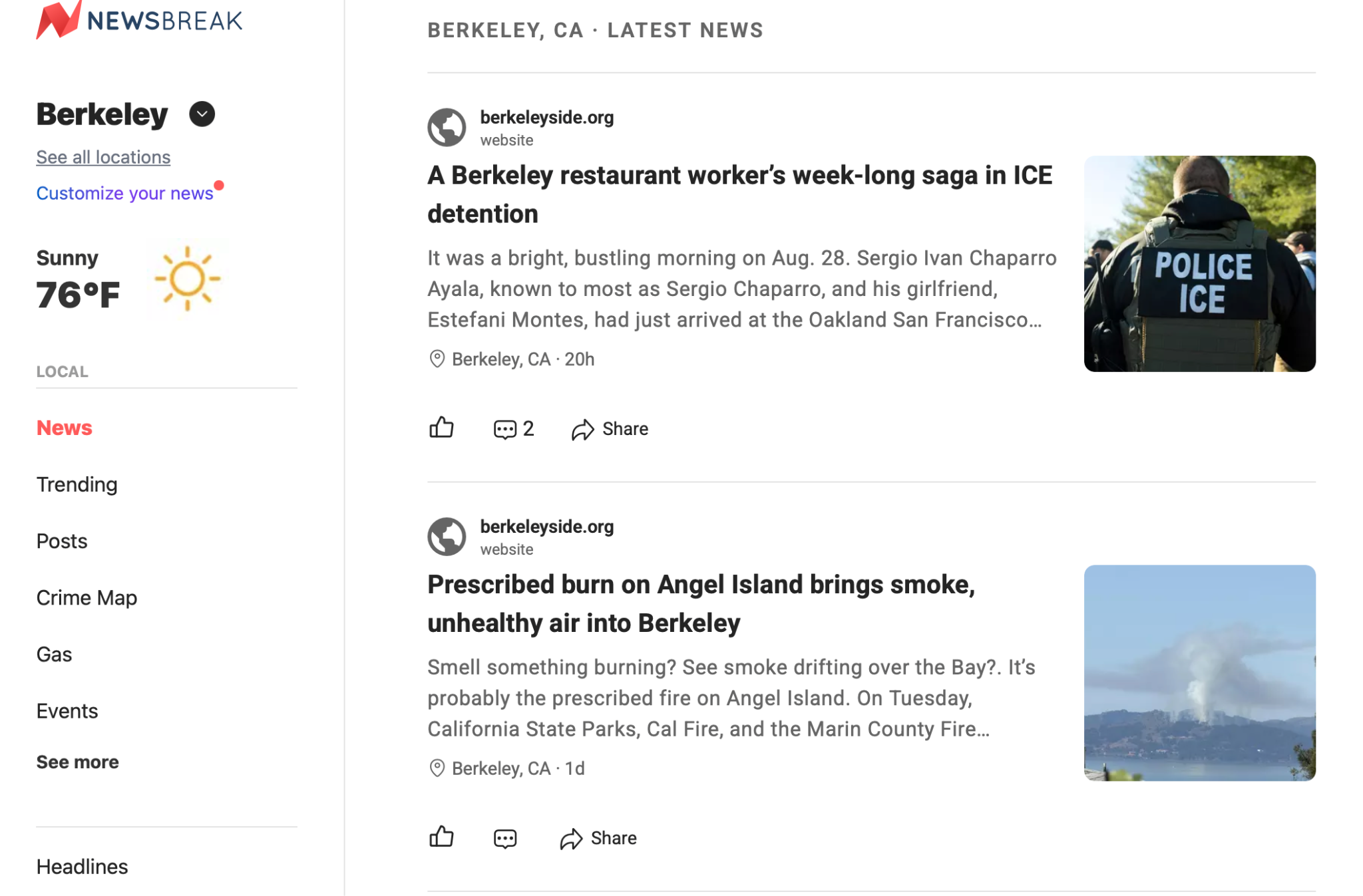
A screenshot of NewsBreak’s webpage. Obtained on 9/11/2026.
For Particle, the stakes were close to existential: a contrary ruling would have exposed a free product to licensing costs spread across tens of thousands of articles. The implication extends beyond NewsBreak to the aggregator business model as a whole.
Anchored in “transmit,” the Emmerich court’s decision turns on a new doctrinal twist. As analyzed below, “transmit” lends itself more naturally to online framing cases than “fixed,” which the Ninth Circuit interpreted to require reproduction and storage when it built the server test. That test dates to 2007, when the Ninth Circuit decided Perfect 10 v. Amazon. Perfect 10 had sued Google for, among other things, displaying its copyrighted full-size images within Google’s own page after a user clicked a thumbnail in Google Image Search.
The Server Test
Under the server test, embedding or framing electronic information for a user on one’s own website is not infringing as long as the actor “does not store and serve the electronic information.” To store and serve the electronic information is to copy and then transmit it to the user. But in-line linking, which is backbone technology at issue, only incorporates content from other websites’ computers by way of HTML instructions, where the back-end code only determines the visual presentation of the content.
The technology of in-line linking is what enables the user to see the full-size image that Google Image Search provides after a user clicks on the corresponding thumbnail image. In other words, Google shows the content from another website’s computer without ever copying and serving it itself.
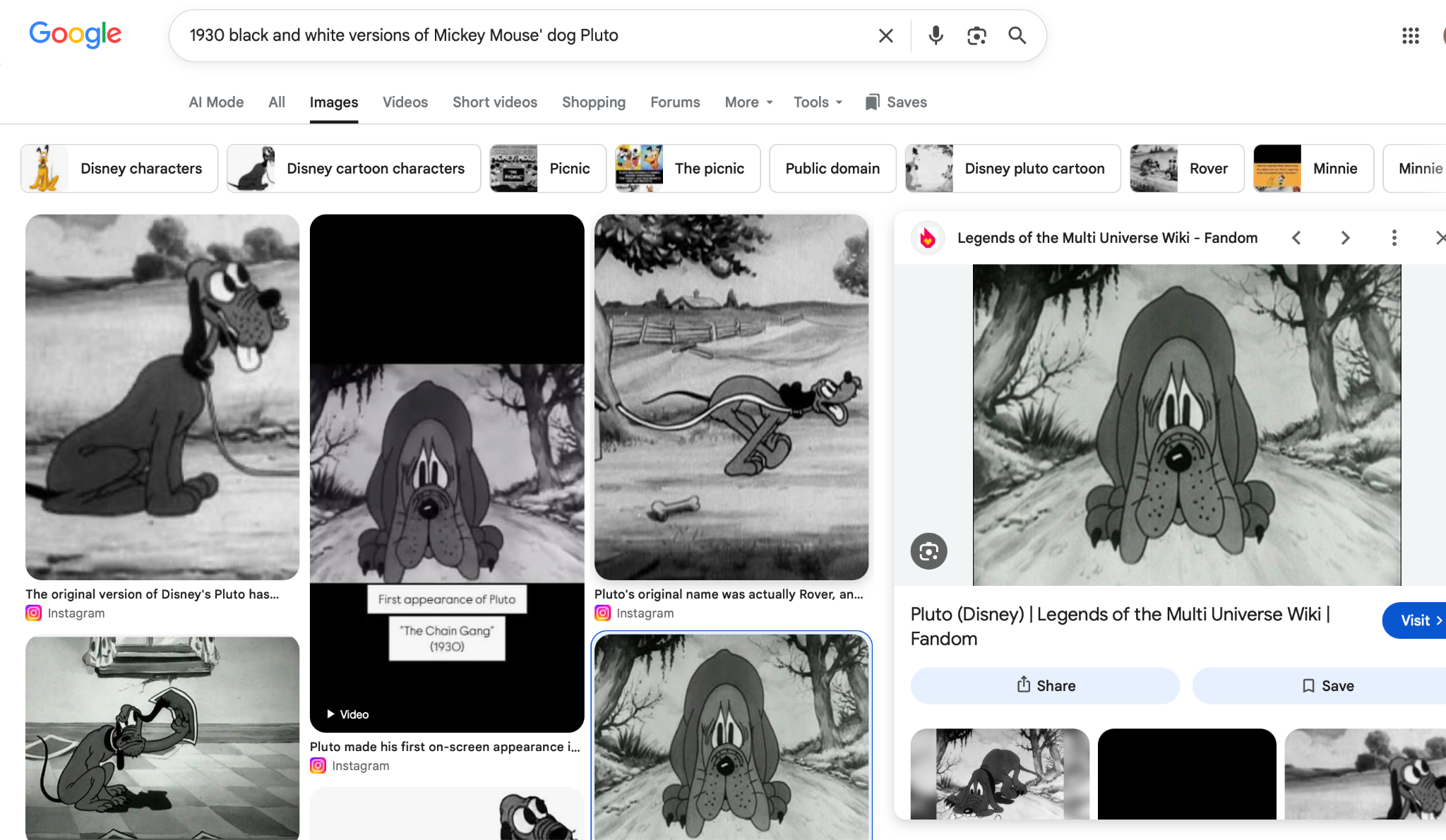
As much as it may seem like Google displayed the full image of Pluto directly on the left side, the back-end code is built so that storage never happens in the first place. The 1930 versions of Pluto entered public domain in 2026.
Because of how in-line linking works, the gap between displaying for copyright purposes and “displaying” in the ordinary sense is stark, since a nontechnical viewer would be under the impression that the embedding website is “displaying” it. The Ninth Circuit recognized as much, and so did the Fifth Circuit in Emmerich, quoting Perfect 10: “[T]he Copyright Act, unlike the Trademark Act, does not protect a copyright holder against acts that cause consumer confusion.”
To get to the server test, the Ninth Circuit followed a three-step chain through the statute. First, to “display” a work means “to show a copy of it, either directly or by means of a film, slide, television image, or any other device or process.” This gets to the second part of the analysis: “copies” are “material objects . . . in which a work is fixed by any method.” Finally, a work is “fixed” when its embodiment “is sufficiently permanent or stable to permit it to be perceived, reproduced, or otherwise communicated for a period of more than transitory duration.” Relying on the text, the Ninth Circuit reasoned that the full-size images were not fixed because in-line linking stored no copies on Google’s servers.
But you may wonder: what about “perceived” or “otherwise communicated”? Wouldn’t either suggest that Google fixed the copies by communicating them to users, or letting users perceive them, through in-line linking anyway? The server test effectively reads the other two statutory routes to embodiment out of the definition.
This gets us to the Emmerich court’s quarrel with the server test.
The Fifth Circuit’s problems with the server test
The Emmerich court’s objection was that the server test asks more of fixation than the statute does. “The definition of ‘fixed,’” the court wrote, “does not require permanency or possession.” A work is fixed if it is embodied for more than a transitory duration — that is the whole test. Grounding an entire limiting doctrine in that one word was, the Emmerich court concluded, a stretch: “the statutory basis for grounding the server test in that term alone is lacking.”
This is because, even though the visual presentation is accomplished through in-line linking — which copies nothing of the content — the presentation itself “is not necessarily so fleeting that it could not meet the definition of ‘fixed,’ meaning embodied for more than a transitory duration.”
Again, the statutory language leaves “perceived” and “otherwise communicated” as options in addition to “reproduced” for satisfying the embodiment requirement. The server test, in the view of the Fifth Circuit, reads the statute as though reproduction were the only option available.
The transmit requirement
The Copyright Act protects the public display right. And this is what the Emmerich court relied on to find for Particle. To display publicly, according to the Copyright Act, means “to transmit or otherwise communicate” it “to the public, by means of any device or process beyond the place from which they are sent.”
From that, the court built a two-step inquiry, and stated it plainly: “The ‘transmit requirement’ is two-fold: first, locating where the transmission originates and, second, determining whether the transmission was permitted.”
On the first step, the question is who actually sends the content “beyond the place from which they are sent.” Here, as with the linking technology discussed above, the links on NewsBreak’s page simply direct the reader’s browser back to Emmerich’s own servers, and “one cannot transmit content it does not have.” The court analogized the transmission to telephone to make the point: “Particle cannot connect a user to Emmerich’s content without Emmerich’s transmittal of the content. Just as the critical act in having a telephone conversation is someone picking up the other end, we find that the critical act in the linking process is the transmittal of content.” Pointing or directing a browser “to request and receive the copyright owner’s own copy does not involve transmitting” the work (emphasis original).
Interestingly, the court read an element of control — a signal of who is actually responsible — into the text of the public display right. “To show” means “cause to be seen,” the court said. Citing the Amicus Br. of Copyright Scholars, the court explained: “The Copyright Act’s definition of ‘display’ requires a defendant to ‘show a copy’ of a work — not merely point to one that someone else has shown.” In other words, merely connecting viewers to the work is not displaying it.
None of this lands far from where the Ninth Circuit already was, and the Fifth Circuit said so: “Although we take different routes to get there, both the server test and the test we announce end up in a similar place: a website cannot transmit a work that it does not have.” Both, it added, “seek to limit the broad display right in accordance with the statutory text.” The difference is the statutory footing: “We differ only in that we find hinging on ‘transmit’ to be more faithful to the statutory text — and more constraining — than the Ninth Circuit’s reliance on the term ‘fixed.’”
On a technological level, the transmit requirement “rests on how the linking technology works,” said the Fifth Circuit. It shares the same technological foundation as the server test — both tests ultimately turn on which server’s code answers the viewer’s request.
Moreover, the two tests converge where the linked content sits on a pirate site that doesn’t copy and store the work. There the embedder is, at most, secondarily liable for the pirate site’s public display infringement, because it neither transmits (under the transmit requirement) nor stores the content (under the server test).
But just as two different people are under the masks of the pointing Spidermen, the seemingly identical outcomes of the server test and the transmit requirement convey two different messages to copyright litigants.
What changes, and what doesn’t
Let’s start with what doesn’t change. Under both tests, an ordinary embed or frame – content pulled live from the copyright owner’s own server – is generally not a public display by the embedder. And a site that downloads a work, stores it, and serves it, without permission from the copyright owner, is probably liable under both. In other words, the server test and the transmit requirement test would be practically the same for online embedding cases. This is why Aaron Moss at Copyright Lately doubts that this is the kind of split that draws the Supreme Court’s attention.
What changes is where the analysis points. The server test finds liability if the defendant reproduced and stored a copy on its own server. The message to potential defendants is essentially: don’t copy, and you won’t be liable. The second step of the transmit requirement turns the question around and puts it to the copyright owner: did you permit the transmission? So what, exactly, does “permit” mean?
Here, Emmerich is the party having control over the dissemination of its content. Emmerich could have used no-archive meta-tags, HTML instructions that can “block the receiving site from embedding material,” or paywalls, which “can operate as one method of prohibiting viewers from accessing content that requires an account, subscription, or the like,” said the court. (Emmerich opinion at 33-34).
Notably, a paywall alone does not make a transmission unauthorized. Emmerich used a paywall for full view of some of its content, but indexing the portions that sit outside it is not circumvention — Particle needed no special tools to “break into Emmerich’s house,” as the district court put it. The Fifth Circuit deferred to the district court’s finding that Particle didn’t circumvent Emmerich’s technical controls.
Thus, the transmit requirement, unlike the server test, sends a message to copyright owners: if you don’t want your work shown elsewhere, configure your server to say so.
But what about authors who cannot configure anything? This is the question with the most direct bearing on individual authors. A writer who posts her work on a platform she does not control — e.g., Instagram — cannot set a no-archive meta-tag or instruct a server to refuse an embed request. The platform makes that choice for her, and it generally makes it in favor of sharing. In Hunley v. Instagram, the Ninth Circuit held that, under the server test, third party sites embedding the photographers’ Instagram content didn’t infringe on their public display right. Under the transmit requirement, however, the answer may instead turn on whether a platform’s technical settings can fairly be attributed to the author at all. And that is an important way in which the permission prong may lead to different case outcomes than the server test down the road.
Bringing performance and display rights closer
The Copyright Act provides that the performer is the transmitter under the public performance right. (“To perform . . . a work ‘publicly’ means to transmit . . . a performance . . . of the work . . . to the public . . . ”) In American Broadcasting v. Aereo, the Supreme Court found that Aereo, which streamed live television programs to paying subscribers online, performed by transmitting the relevant audiovisual works publicly.
Focusing also on the question of who transmits, the transmit requirement test draws public display and public performance rights closer: under it, one cannot display the content without also transmitting it. Courts may draw from the transmit requirement test – especially the second prong – in deciding whether streaming by embedding videos from an online streaming service’s own server constitutes public performance.
How other circuits will weigh in regarding online embedding is a live question. We’ll keep reporting if and when the next court of appeals takes it up.
Discover more from Authors Alliance
Subscribe to get the latest posts sent to your email.