
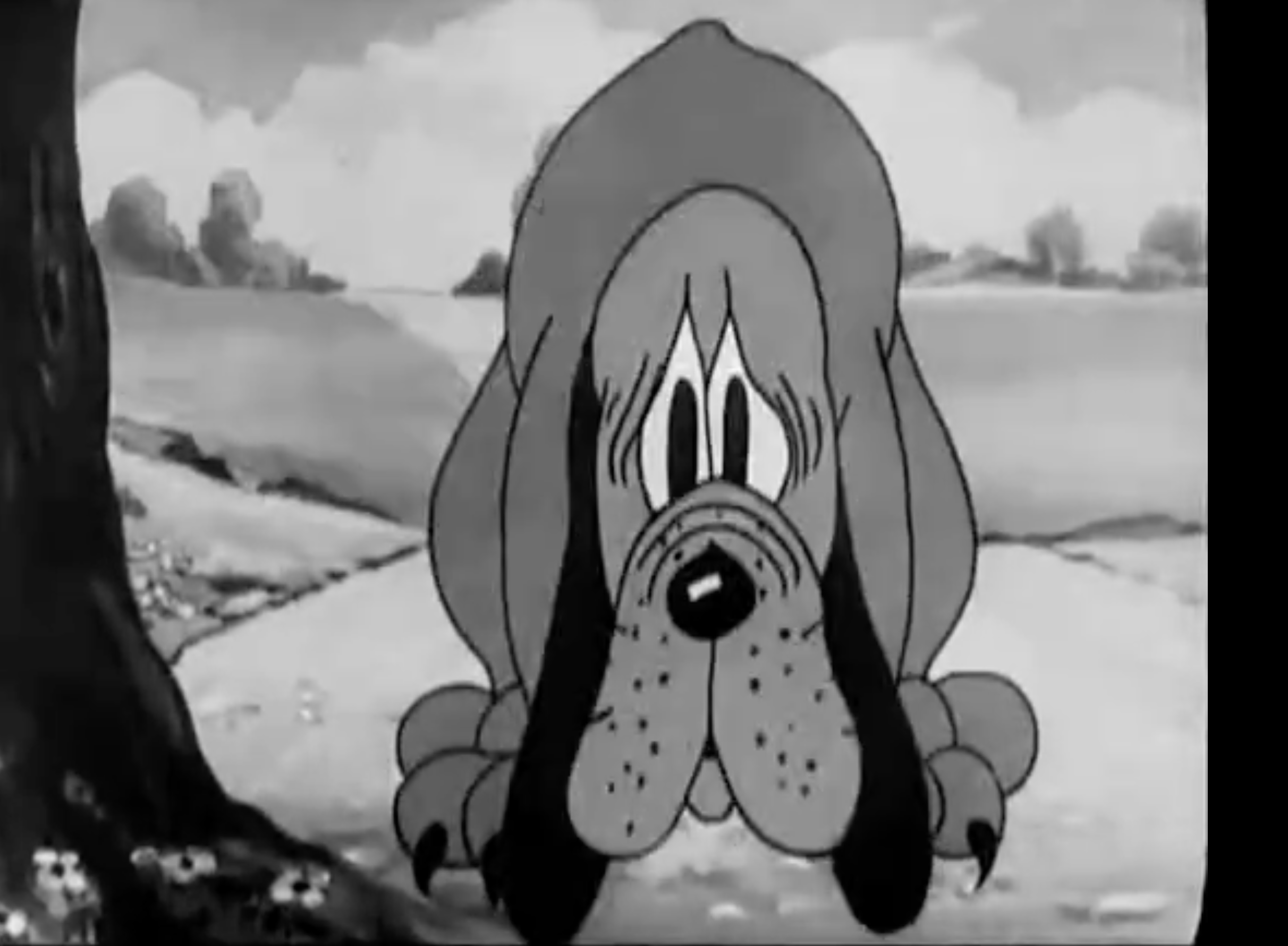
Rover, later named Pluto, first appeared in 1930’s The Picnic as Minnie Mouse’s dog.
Happy Public Domain Day, everyone! Because copyright terms expire at the end of their last calendar year, a whole lot of works entered the public domain at midnight last night. For many years now, civil society organizations, cultural rights groups, and copyright law nerds (of which we confess to being all three) have marked the annual day when the public domain grows. In the United States, the public domain’s new class includes works (except sound recordings) published in 1930 whose copyright was renewed. It also includes sound recordings published in 1925 (that is a long story).
Celebrations around public domain day normally focus on the luminaries from the new entering class. In the United States, this year includes the animated characters Pluto the Dog (né Rover) and Betty Boop (contra wishful claims by the studio); literary works including (my personal favourite) The Little Engine that Could; Hoagy Carmichel’s Georgia on My Mind (but not Ray Charles’s classic performance); and the Marx Brothers movie, Animal Crackers. Each year our friends at the Center for the Study of the Public Domain do a terrific post for their favorite National Holiday, and this year is no exception! You can find their 2026 post, here.
But as the CSPD post also discusses, the celebrities of the public domain are remarkable not just for their star power, but also for how few of them there are. The majority of the now-expired copyrights are neither famous nor profitable. The works we most often celebrate on Public Domain Day are, for the most part, anomalies. They are the ones that, despite the passage of nearly a century, remain well-known or profitable. Very, very few works have that kind of staying power. Most titles will simply spend the rest of existence in total obscurity.
How many is that? Well, it is not possible to know exactly how many works from 1930 were copyrighted, because any work that was published with a sufficient copyright notice was copyrighted for 28 years. But we do know approximately how many works entered the public domain last night. That is because any work whose copyright expired last night also had to be renewed, and renewal (for a further 67 years) was contingent on registration with the Copyright Office during the last year of the initial term—not before or after—as measured by the publication date.
That means that the works in this year’s public domain class were renewed during either 1957 or 1958. And the Copyright Office’s records of renewals mean we can put a number on them. According to this website, run by the University of Pennsylvania Libraries, the average number of renewals during those two years was a little under 22,000. In all likelihood, that is roughly how many works entered the public domain last night. By contrast, the most generous lists of public domain notables that I’ve seen have included no more than a hundred or so works.
And there is likely a reason for that. To understand why, remember that, prior to the Copyright Term Extension Act of 1998, the maximum copyright term was 75 years. When Congress was debating extending the term to 95 years, one option they considered was whether the additional 20 years should be automatic or require an additional renewal. Renewal would require an additional renewal registration, for which the Copyright Office would have charged a fee.
Congress did not, of course, do so. But what if they had?
This report, from the Congressional Research Service, analyzed the economics of a fee-based extension. Among its many interesting conclusions was that if the fee were set at $100, the Copyright Office’s expected revenue from fees for renewals of books, movies, and music would combine to a total of $377,000 during the first five years after enactment. That means the expected number of renewals in those three categories during that period would be 3,770, or an average of 754 renewals per year. Of the 22,000 members of this year’s new public domain class, roughly 16,000 were books, movies, or music. Boiling the math down, the bottom line is the Report anticipated only about 5% of books, music, and movies would likely be renewed for the first five years after enactment.
Why so few? Because the economics of renewal assume that someone will not pay a $100 fee to renew the work, to say nothing of the hassle of doing the paperwork, unless they will gain at least $100 in value from continuing to hold the exclusive right for 20 more years.
Look at that again. Out of roughly 16,000 eligible books, movies, or music, no more than five percent could expect to earn more than a total of $100 in the space of 20 years. The rest of the works—more than 15,000 of them—were expected to be worth less than five dollars per year (economically speaking) to their rights holders. And remember, these were the numbers based on 75 years of copyright. The numbers would likely be even more disparate if further term extension were to be studied today.
This is not at all to say that the works are not worth more than $5 per year to society. To the contrary, there are enormous potential benefits to society in having those works available for the public to use. A forgotten character from an obscure work could find new life as a beloved classic—possibly even with substantial new economic value—if the burden of securing permission is removed. New derivative works could provide the public with enjoyment and economic growth. And this is to say nothing of the academic and critical uses that might be fair uses in the first place, but for which the reduction of risk might spur further use.
So today we celebrate a few dozen or so well-known titles out of thousands—thousands of works for whom the market impact of PD Day on their now-former exclusive rights holders will likely be immeasurably small. Some of those works—the lucky ones—might see revival as a result of entering the public domain. Sites such as the Public Domain Review, which publicize public domain works, bring attention to works that otherwise have been largely forgotten.
But if this year’s numbers are typical—and there is no reason to think they aren’t—they illustrate how today’s public domain day is a shell of what it could have (and we think should have) been. They make painfully clear how the present copyright terms are placing a staggering burden on the public’s right to a return on its investment in copyright. After all, the copyright bargain is that the author receives a temporary monopoly on her works, as an incentive to create, with the expectation that the work will one day escheat to the commons.
By all means let us celebrate Public Domain Day! But let’s keep in mind that the celebration is in a sense also a mourning—for the loss to the public that ever growing copyright terms have imposed in the name of protecting a few high profile properties.
Discover more from Authors Alliance
Subscribe to get the latest posts sent to your email.