
This is the latest in our series of posts marking the 50th anniversary of the Copyright Act of 1976. To find a list of all the posts in this series, click here.
In Folsom v. Marsh, Judge Joseph Story famously referred to copyright as the “metaphysics of law.” Even in 1841, when copyright’s scope was limited to books, maps, charts, and musical compositions, copyright was a puzzle.
Folsom is remembered mostly for its articulation of the principle of fair use, now codified in Section 107, but the metaphysics really gets going in Section 106, the section every previous section has been building to. Section 101 defined a whole bunch of terms, and Sections 102–105 described what sorts of things copyright applies to, but up to this point we don’t really know what copyright is. We don’t know what it does. Section 106 is where the verbs come into play—it defines relationships between the subject matter, the authors, and the public.
Section 106 is often described as a “bundle of rights,” and in one sense it is. As so many of us have recited more times than we can remember, there are six (or five, depending on how you count) exclusive rights. Section 106 is the last section we’ll have for a while that is short enough to include in its entirety, so here it is:
106. Exclusive rights in copyrighted works
Subject to sections 107 through 122, the owner of copyright under this title has the exclusive rights to do and to authorize any of the following:
(1) to reproduce the copyrighted work in copies or phonorecords;
(2) to prepare derivative works based upon the copyrighted work;
(3) to distribute copies or phonorecords of the copyrighted work to the public by sale or other transfer of ownership, or by rental, lease, or lending;
(4) in the case of literary, musical, dramatic, and choreographic works, pantomimes, and motion pictures and other audiovisual works, to perform the copyrighted work publicly;
(5) in the case of literary, musical, dramatic, and choreographic works, pantomimes, and pictorial, graphic, or sculptural works, including the individual images of a motion picture or other audiovisual work, to display the copyrighted work publicly; and
(6) in the case of sound recordings, to perform the copyrighted work publicly by means of a digital audio transmission.(emphasis added)
Exclusive rights are the foundation of property. If you own a piece of land, you have several rights to use your land—you generally have the rights, for example, to occupy the land, to sell it, to rent it, to take loans on it, and to develop it. But despite having all those rights, the land would not feel like your property unless you also had the power to exclude others from making that use. If you have the exclusive right to occupy the land, then I cannot occupy it. Similarly with personal property, if I own my computer, then you’re not allowed to take it home with you unless I grant you permission.
Economists have written many volumes on the twin axes of rivalry and excludability. Something is rivalrous when one person’s consumption of it diminishes others’ ability to do so. Something is excludable when its owner can exclude others from it. Land is rivalrous: when you farm your land, there is less land available for me to plant apple trees. A computer is excludable: if I have it, you can’t have it unless I hand it to you.
The problem presented by intellectual work is that it is neither rivalrous nor excludable. If I write a song and you sing it, I can still sing it, too (non-rivalry); and if you hear the song, I have no way to keep you from singing it (non-excludability). For more on this, I recommend one of my all-time favourite books, James Boyle’s The Public Domain: Enclosing the Commons of the Mind.
Law can’t make something less rivalrous, so it targets excludability by granting exclusive rights to authors. Section 106 is all about actions, and each of the uses it lists is ultimately for the purpose of controlling others’ ability to make those same uses. In that sense, Section 106 is not so much a bundle of rights as a grant of a single right: the power to exclude.
What do you get to exclude, and who do you get to exclude? That’s where the rest of the text comes in. First, we learn what exclusive rights the author and subsequent owners have: the owner has the right to do things (and to exclude others from doing them), and they have the power to authorize others to do those things (and exclude others from granting that authorization). That power to authorize is at the heart of secondary liability, where a party can also be responsible for infringement even if they did not make the infringing use. An example is the music sharing services, such as Napster and Grokster, of the late 1990s. Their infringement was not the copying and distribution itself—they infringed on the right to authorize, by inducing others to do the copying.
Those two exclusive rights, in turn, apply to various uses that can be made of a work. The right holder alone can do or authorize others to do five things: reproduce the work, prepare derivative works, distribute the work, publicly perform the work (digitally, if it is a sound recording), and publicly display the work. Though these five uses are where the eye naturally turns as a focus for the section, they are not independent rights so much as acts over which one can exercise the power to exclude.
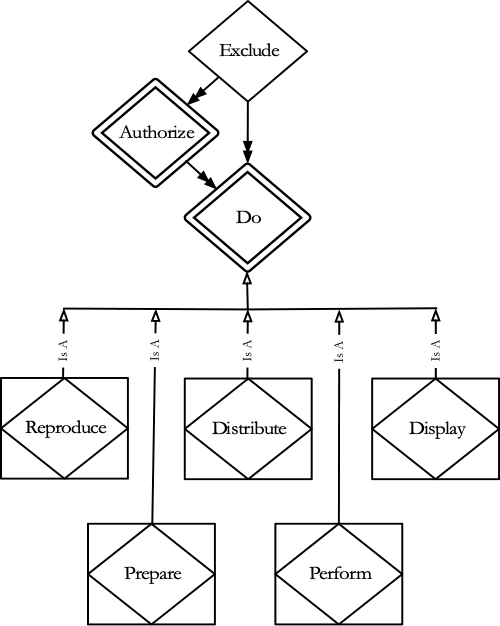
Putting it all together, Section 106’s hierarchy of verbs could be represented this way:
Ontology is the branch of philosophy that worries about logical relationships that exist in the universe. I first encountered ontology in library school at the University of Illinois, where probably half my classes concerned the “Functional Requirements of Bibliographic Records.” FRBR, as it is known, is an example of an applied ontology—it was an attempt to improve metadata development by examining the ontological relationships in the bibliographic universe. The FRBR report never called it an ontology, but that’s what it is.
A blog about law is probably not the first place you’d expect to hear about ontology, but ontology and law intersect often, and sometimes in amusing ways. As far back as 1893, the Supreme Court of the United States was asked to weigh in on whether a tomato was a vegetable or a fruit (answer: a vegetable—apologies to any botanists out there). Is a taco a sandwich? A court in Indiana ruled that it was. As this post from the Library of Congress’s excellent In Custodia Legalis blog shows, food law is especially (ahem) ripe with ontological questions.
Now back to Section 106. In the diagram, I’ve tried to model Section 106 as an ontology, roughly using a conceptual entity-relationship diagram. In a typical entity-relationship model, rectangles are used to show entities (usually nouns or noun equivalent), and diamonds are used to show relationships. Diamonds within rectangles are associative entities, a kind of hybrid having qualities of both entities and relationships. Double-walled shapes are “weak,” which means they are dependent on other entities or relationships.
Section 106, as I’m trying to argue, is really all about defining relationships, so the diagram is nothing but diamonds. How they fit together is illuminating.
You can’t authorize an entity; you can only authorize a further action, so “authorize” is weak. The five exclusive rights are associative entities, in part because of their relationship with the “do” relationship. The five are connected to “do” through an “Is-A” relationship—each is an example of something one can do with a work. Performing “is a” thing you can do; distribution “is a” thing you can do; and so forth.
But these are things the right holder can do with or without an exclusive right—for everyone else, they are things one can’t do. And that is why even though “exclude” might ordinarily also be weak, since it depends on what you exclude, it is represented as strong in my model. Everything depends on the power to exclude. These are relationships I find difficult to spot in Sec. 106 when I view it simply as a list of six rights.
If you’ve gotten this far, you may be wondering whether there is a point to all of this beyond a nerdy academic exercise. And there is. I promise. We’re almost there.
In the 1909 Copyright Act, each of the exclusive rights was included in the same breath as its exceptions. For example, the Act granted the exclusive rights to reproduction and distribution for reprinting, publishing, copying, and vending—it identified a right and then limited it all at once. Likewise, the exclusive right to perform a musical work publicly was granted in for-profit performances—the exclusive right and its outer limits all in one package.
In the 1976 Act, Congress tried something different. The House Report makes clear that Congress’s goal was to draw the broadest possible circle around the rights it intended to protect in Section 106, and then to add limitations in the subsequent sections. For example, Congress granted an exclusive distribution right in Section 106, and then placed limitations on that right in Section 109.
Section 106 states at the outset that it is subject to Sections 107–122. The House Report emphasizes the intended meaning, that the opening means Section 106 can only be read in conjunction with the limitations and exceptions that follow. But in separating the exclusive rights from the limitations on those rights, I think Congress made it easy to forget what was clearly understood prior to the Act’s passage: that exclusive rights and their limitations are two halves of the same thing. And in doing so, they put the limitations on an unnecessarily poor footing.
This is especially the case with fair use. When the Copyright Office studied the question of what to do with fair use in the new act, many of the published responses to the study circled back to a common theme: that fair use is inherent in the exclusive rights themselves. In the universe of uses for a work, the presumption was not that they were protected unless there was an exception (as Section 106 suggests)—to the contrary, the presumption was they were not protected unless there was an exclusive right. Fair uses were not simply a permitted exception to copyright—they were not subject to exclusion to begin with. All of this reminds me of another famous ontology:

In Taoist philosophy (as I understand it), the taijitu is a model of relationships between the forces at work in the universe. It contains five layers, the most famous of which shows two opposite forces: yin and yang. Though they are opposite, each is the other’s source. They support and complement one another, and neither can exist without the other. To have balance, both aspects of the chi (the complete circle, representing the universe) must not only be present, but must be equal. Copyright, too, must be balanced, as we remind anyone who will listen.
My model is a complete model of Section 106, but it is still incomplete. What is missing is the white space—the uses that are not excludable under the Copyright Act, where one does not need permission. If Section 106 is, as Congress appears to have intended, the entire universe of protected uses, it is missing its other half. It is missing the rest of the uses—the fair uses. The two are as inseparable as are the yin and yang.
The separation of the two has placed fair use on the defensive. Literally. Section 107 is often referred to as the “fair use defense.” Fair use, it is true, is asserted procedurally as a defense. But the separation has created a perception that a fair use assertion first requires an admission of liability, as if to say, “I crossed on to your land, but I had a good reason.” As the legislative history and case law before it makes clear, though, fair uses were never infringements to begin with. A better response to the trespass charge might instead be, “I was on the land, but I was covered by a public easement.”
Judge Story’s appeal to metaphysics was, to me, surprisingly on point. Metaphysics is, after all, a parent philosophical branch of ontology. Folsom was about the limits of exclusive rights; in Judge Story’s world, there was no separate doctrine of fair use—just a natural limit on what could be excluded. Today, we have discerned differences between rights and limitations, but have forgotten their essential wholeness. Fair use is not a carve-out—it never has been. It is part of what Section 106 means.
The ontology of copyright is incomplete when rights and limitations are fractured. I think Congress’s doing so has caused copyright to wobble.
Discover more from Authors Alliance
Subscribe to get the latest posts sent to your email.