
This is the latest in our series of posts marking the 50th anniversary of the Copyright Act of 1976. To find a list of all the posts in this series, click here.
When we launched this series, I hinted that, though we would be reading through Title 17 mostly in order, we would occasionally break the sequence and sometimes would combine multiple sections where it made sense. In this post, I’m doing both, skipping ahead to Chapter 10 of Title 17, where we find the Audio Home Recording Act of 1992 (AHRA). Among Title 17’s fifteen chapters, Chapter 10 may be the most . . . quaint. It isn’t even really a copyright law. It is almost certainly the last place one would expect to turn at this point in the series. But I have a reason, which I’ll get to later in this post.
📀 Track 1: A Day In The Life, by Generation X.
But first, some background. If, like me, you are a child of the 1980s, then you will remember the mixtape. The closest modern equivalent is a shared streaming playlist, but mixtapes were a great deal more. Listening to music on the radio, or on commercial stereos, we compiled cassette tapes of favourite songs, classic advertisements, radio call signs, and air checks from our favourite announcers, and then added often meticulous track information and even elaborate label art to create one-of-a-kind multi-media collages. For many mid- to late-Gen Xers, it was our defining communications tool. We shared mixtapes with our friends (even our enemies). We shared them in moments of joy and of sadness. Mixtapes were often how we flirted, broke up, and apologised, and especially how we tried to cope. If we didn’t know how to say it (and at that age, few of us did), we could turn to a mixtape.
Mixtapes raise several copyright questions. By definition, they contain multiple unauthorized reproductions and distributions, and arguably constitute unauthorized derivative works. Whether they are copyright infringements was a point of contention, but it was not an urgent question because the mixtape was made possible by the cassette recorder, which was an analog recording device. Since each reproduction was from an analog source to an analog destination, each successive reproduction was inferior in quality. Compact disc (CD) players, introduced in 1980, allowed for a digital source, but the destination was still analog, since few consumers had the professional model equipment to record to CD. Mixtapes had obsolecense—known in preservation circles as “generation loss”—built-in to their structure. So the recording industry looked the other way.
Everything changed in 1987, when Sony introduced the Digital Audio Tape, or DAT. The advent of DAT recorders signalled the possibility of widespread digital-to-digital reproduction by average consumers. No analog element meant no generational loss, which meant the physical limitations of analog personal recording devices vanished. The possibility now existed for consumers to spread thousands of perfect copies through the market, obviating the need for purchasing commercial copies. With DAT, the perceived threat of consumer recording went from negligible to existential.
Stakeholders looked to Congress for a fix, but it was not a simple matter. In the face of increased infringement (either actual or feared), the first proposal is often additional enforcement, but here that was unworkable. I don’t think it is an exaggeration to estimate tens or possibly hundreds of millions of people were in the habit of using cassette recorders to supply curated playlists for themselves in their daily lives. Many of those uses were undoubtedly fair, but the extent of fair use in that context was not settled. Congress did not relish the prospect of imposing laws that replaced the established norms of millions of Americans with infringement actions and subjected them to many thousands of dollars in statutory damages. But no one wanted the new technology to threaten the recording industry, either.
Given the predicament, Congress tried something new—its first foray into using collective funding, rather than private enforcement, as the balancing force.
📀 Track 2: Chapter Ten, by The Usual Suspects
The Audio Home Recording Act created a levy on consumer digital recording equipment, which raised funds to be distributed to creators and other interested parties. In exchange, consumers received permission to use those devices for personal purposes. To control the downstream spread of digital copies, Congress required all covered devices to include the Serial Copy Mangement System (SCMS), a technical limitation on digital copies designed to mimic generational loss. Compliant DAT recorders could make first generation lossless copies of original digital recordings, but had embedded locks preventing them making second generation copies.
Since I’m collapsing ten sections into a single blog post, here is a quick tour of the AHRA. The Act creates Chapter 10 of Title 17, and divides it into four subchapters.
Subchapter A (Sec. 1001): Provides definitions for terms used throughout the chapter. The definitions are pretty clunky, but the most important term turned out to be the definition for “Digital Auido Recording Device,” which was limited by definition to devices whose primary function was creating music recordings for personal use. The AHRA was unconcerned with spoken word recordings or with other forms of digital data.
Subchapter B (Sec. 1002): Imposes the SCMS requirement on device manufacturers, and includes provisions for verification and enforcement of the requirement. Sec. 1002 also prohibits circumvention of the SCMS system, making the AHRA Congress’s first technical protection measure, a concept which reappeared in a broader form in the Digital Millennium Copyright Act of 1998.
Subchapter C (Secs. 1003–1007): Establishes the royalty fund, and requires device manufacturers or importers to pay 2% of the sale price of the device (a total of at least $1 and no more than $8 per device) into the fund. It also provides the formula for distribution of the funds to “interested copyright parties” (defined in Sec. 1001), which are: the composers and publishers of musical works; the owners of sound recordings; the featured artists on those recordings; and the industry groups that represent them.
Subchapter D (Secs. 1008–1010): Finally, Subchapter D provides for enforcement, and defines potential statutory damages under the AHRA. It also provides the users of AHRA-compliant “Digital Music Recording Devices” with immunity from lawsuits under the Copyright Act for noncommercial uses, and releases manufacturers and distributors from secondary liability.
Chapter 10 is the first sui generis law we’ve covered in this series. If something is sui generis, it is separate and self-contained, in more or less the way that an ad hoc committee differs from a standing committee. The AHRA interacts with copyright law, but it is outside the system established by the 1976 Copyright Act. This is why the AHRA is not, strictly speaking, a copyright law. It is related to copyright, and so is included in Title 17, but it is in its own class and interacts with the copyright provisions of Title 17 (such as duration, exceptions, etc.) only where it specifically says so, rather than by default.
📀 Track 3: Computers Killed the AHRA Star, by The Market Force
If you were alive in the 80s and are wondering how you missed the saga of DATs, it may be because DAT as a format was short-lived and never became popular in consumer-level products (speaking as a former special collections librarian, it was also a terrible format). When recordable CDs (CD-R and CD-RW) were introduced, they quickly supplanted DAT.
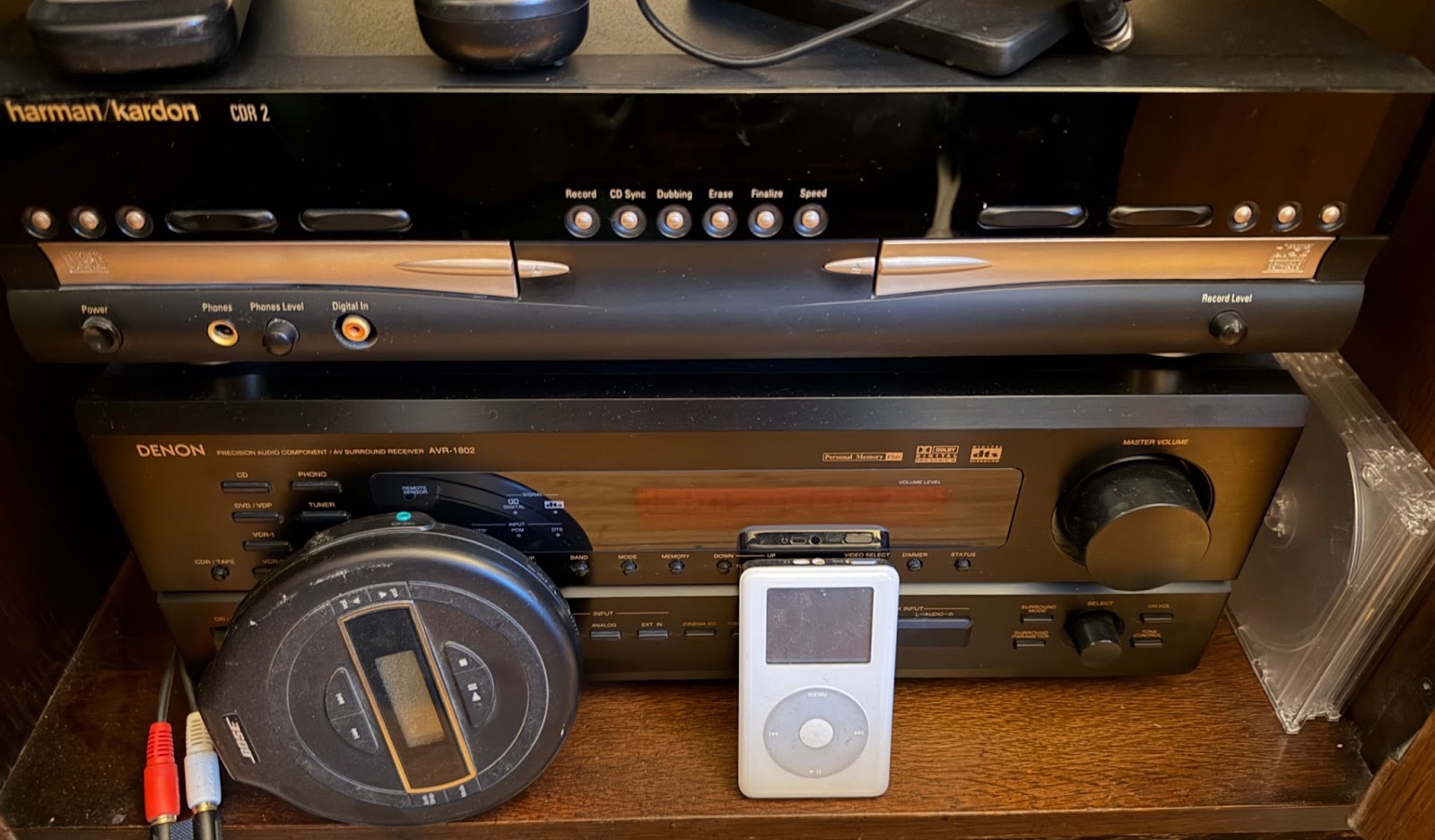
The AHRA applied to CDs and audio CD recorders, too, but unlike DAT, recordable CD’s usefulness extended far beyond audio recording. They were highly useful, for example, for storing computer data. But digital audio is simply digital data in an audio format, and so users could also use computers to record digital audio in digital formats. (DAT could store data, too, but was never widely used for that purpose). As a result, consumers had two choices for digital-to-digital audio recording: they could use Digital Audio Recording Devices (as defined in Sec. 1001), such as dual CD stereo components, or they could use their computers. If they wanted to use their computers, they could use any CD-R; if they wanted to use dedicated recorders, they needed to buy “Music CD-Rs,” which were the same thing but with SCMS encoded in them.
Though physically no different, Music CD-Rs were much more expensive because their price typically included the cost of the royalty fund levy. My recollection is a spindle of five Music CD-Rs cost roughly the same as a spindle of 50 data CD-Rs. The difference did not stop there, though, because stand-alone CD recorders, which could only use Music CD-Rs, were limited to lossless, uncompressed recording formats, which allowed roughly fifteen perfect tracks per disc. By contrast, a computer could record using any available format, and using lower sampling rates, allowing roughly 200 lower-quality but passable tracks to fit on the same disc. Meanwhile, SCMS-enabled recording equipment was usable only for audio, but computers, of course, had multiple uses.
Consumers generally prefer lower costs to higher ones, and simpler paths to more complicated ones, and they will often choose simpler, less-expensive solutions at the expense of quality. That is overwhelmingly how they ended up choosing their digital audio. The music-as-data path effectively destroyed the need for SCMS-enabled products. The Recording Industry tried to recover ground by forcing computer and data CD-R manufacturers to pay the AHRA levy, but the Ninth Circuit, in RIAA v. Diamond, halted that effort when they ruled that MP3 players—tiny computers designed for playing digital music files—were not “Digital Audio Recording Devices” as defined by the AHRA. Eventually, the system collapsed. The royalty fund, which in 2000 had over $5 million, had been completely disbursed by 2015, effectively ending the AHRA experiment.
📀 Track 4: Back to the Future, by The Past Lives
We are once again in an era where we must decide how to adapt to a profoundly disruptive technology. Like DAT in 1987, the release of generative large language models in 2022 has raised fears that the disruption will cause the collapse of long established business models, and especially in the creative industries. Those fears—many of them understandable—have given rise to a variety of proposed solutions. In addition to the roughly 100 ongoing lawsuits, one of the proposals I’ve seen floated lately is for a levy, to be imposed on AI companies and distributed to creators.
At the beginning of this post, I promised a reason for picking up the AHRA at this point in our series, and here it is: we tried a levy system once before, and it failed, spectacularly. That does not mean a levy couldn’t work in the future—it very well might. But a successful levy would need to learn from the mistakes of its predecessor. Here are three lessons I think a future Congress could learn from its past failure.
Laws work better when they are fully informed by technology. I continue to marvel at how well the Copyright Act of 1976 anticipated future technology, and it did so because Congress engaged in expert-led study that was informed by experts. The AHRA provides a useful contrast—a cautionary tale for laws that are ignorant of the technology they seek to regulate. Once sound is converted to bits of digital data, it can be interpreted and manipulated by anything that can process bits of digital data, whether it is a professional sound component, a laptop computer, or a refrigerator’s internal temperature regulator. And with the right equipment, any such device can share that data with any other such device. “Digital” is a property of the data, not the device.
All of this was well known in 1992. The AHRA regulated specific devices on the assumption the music data would never leave the music ecosystem, which any technologist could have told them was unrealistic. Congress didn’t do its homework, and so the AHRA was doomed to fail. Policy makers looking to legislate around AI would do well to focus on understanding the technology, rather than on understanding the politics of the technology.
Laws driven by intermediaries are unlikely to benefit authors. As soon as a large pot of money appears, there are inevitably parties that are eager for a share, and who will spend heavily to get it. Very often they are parties that are entitled to some of the money, but then use that claim as a wedge to claim an expanded share.
The purpose of the AHRA was ostensibly to benefit creators, but the big winners were the intermediaries—the record labels and the music publishers. Under Sec. 1006, roughly 38% of the royalty fund was distributed to the recording labels—all six of them—and another 17% was distributed to music publishers. The rest was distributed among probably thousands of composers and performers, most of whose share probably was so small as to not be worth claiming. This is to say nothing of the complexity of ensuring equitable distribution among those thousands of creators, by collectives that may not have the creators’ interests at heart.
With pots of more than a billion dollars now at play to compensate creators for the work of AI companies, the courts and Congress should be careful to prioritize the creators themselves and not the louder, better-organized intermediaries.
Laws should be understood before they are changed. In the industry’s digital music panic, mixtapers were never a threat, or a problem. Nor were libraries that lent CDs (many of which certainly ended up being copied), nor friends loaning CDs to other friends, nor teachers making copies for their students to study. As often as not, creators were the beneficiaries of such sharing. The AHRA provided an immunity from suit for some uses, but many of those uses were also never infringements in the first place.
The legislative history shows that Congress spent decades in measured, careful deliberation and consultation with experts before they finally completed the 1976 Copyright Act. One of the things they took pains to establish in that Act was the limits of copyright. As I discussed in an earlier post, exclusive rights are only half of the copyright picture; and the other half, constituting the public domain and fair uses, must be given equal weight. As we have often written, authors need both halves in order to keep creating.
A levy in exchange for an exemption was a novel idea, and it had some merit in theory. In practice, I think the main lesson of the AHRA is that a future levy scheme is probably ill-advised. But regardless, before Congress considers changing the law, it should make sure it understands the law it is changing. Congress should scrutinize who will actually benefit from, and bear the costs of the change, and should take particular care not to inadvertently limit the commons on which authors depend for inspiration.
(© Eric Harbeson, CC-BY)
Discover more from Authors Alliance
Subscribe to get the latest posts sent to your email.