
On September 29, 2026, the U.S. Court of Appeals for the Third Circuit affirmed the district court’s grant of partial summary judgment to Thomson Reuters in Thomson Reuters v. ROSS Intelligence. The panel (Judges Restrepo, Montgomery-Reeves, and Bove, with Judge Montgomery-Reeves the author of the opinion) held that Westlaw’s headnotes are copyrightable and that ROSS’s use of them to train an AI legal research tool was not fair use.
The court insists that “this is no more than an ordinary copyright case” (Ross COA Opinion, p. 2). While we do think the effect of this case will be limited on other blockbuster AI cases, this is the first federal appellate ruling on whether copying works to train an AI system is fair use, and it gets two important things wrong. It hollows out the merger doctrine, and it reads fair use in a way that disfavors the non-expressive, non-public copying the doctrine has long protected. While we hope this decision is not followed by other courts, it is nonetheless worth understanding what this decision gets wrong.
Refresher/Background
As frequent readers of this blog already know, we’ve both written about this case and filed an amicus brief in support of Ross in this appeal.
For a refresher — ROSS set out to build a search tool that would answer plain-language legal questions with passages from judicial opinions. Its system was not generative: it “would only return text passages from preexisting judicial opinions” (Ross COA Opinion, p. 5). To train it, ROSS engaged LegalEase, which wrote roughly 25,000 memos, each pairing a legal question with four to six opinion passages graded from “great” to “irrelevant.” LegalEase’s drafters used Westlaw headnotes to frame many of those questions. Those memos were converted to machine-readable form and used to train ROSS’s model; users of ROSS never saw the headnotes.
Thomson Reuters sued in 2020. Judge Stephanos Bibas initially denied summary judgment in 2023, then reversed course in February 2025, holding that 2,243 headnotes were original, infringed, and not fairly used. He certified both originality and fair use for interlocutory appeal. The Third Circuit has now affirmed on both questions.
We filed an amicus brief in support of ROSS almost precisely one year ago, on September 29, 2025. We took the copyrightability ruling as given for purposes of our argument, while noting our agreement with those who argued the headnotes are not protectable (Authors Alliance Brief, p. 6 n.2).
Our focus was fair use. We argued that the district court “wrongly conflated competing users with competing uses” (Authors Alliance Brief, p. 2), that it wrongly confined intermediate-copying precedent to software, and that it credited a speculative, circular licensing market under the fourth factor.
The Third Circuit has now adopted the district court’s reasoning on each point, and in places extended it.
Footnote 7: a generative AI carve-out with a backward premise
One of the opinion’s most important passages is a footnote. Responding to the Department of Justice’s statement of interest in In re OpenAI and the DOJ’s take on fair use rulings in Bartz v. Anthropic and Kadrey v. Meta, the panel wrote that “[u]nlike the AI models in Bartz and In re: OpenAI, ROSS’s AI platform cannot generate original expression, and the evidence here supports the opposite conclusion about transformativeness” (Ross COA Opinion, p. 17 n.7). The court went out of its way to say its holding does not resolve the generative AI cases. No one should treat this decision as the last word on LLM training.
This is a welcome caveat, and we hope subsequent courts will heed it. But we think the carve-out for generative AI may also be weaker than the opinion appears to intend. Much of the work in footnote 7 is done not by the generative/non-generative distinction but by substitution: “ROSS trained its AI for the purpose of creating a commercial substitute for Westlaw” (Ross COA Opinion, p. 17 n.7). Plaintiffs in generative AI cases will surely use this case to argue that any model competing in their market belongs on ROSS’s side of that substitution line.
The footnote also closes by noting that the DOJ “notably did not” weigh in here (Ross COA Opinion, p. 17 n.7). This struck us as a particularly strange thing for a court to treat as bearing on how fair use applies.
Merger can apply even if there is more than one way to express an idea
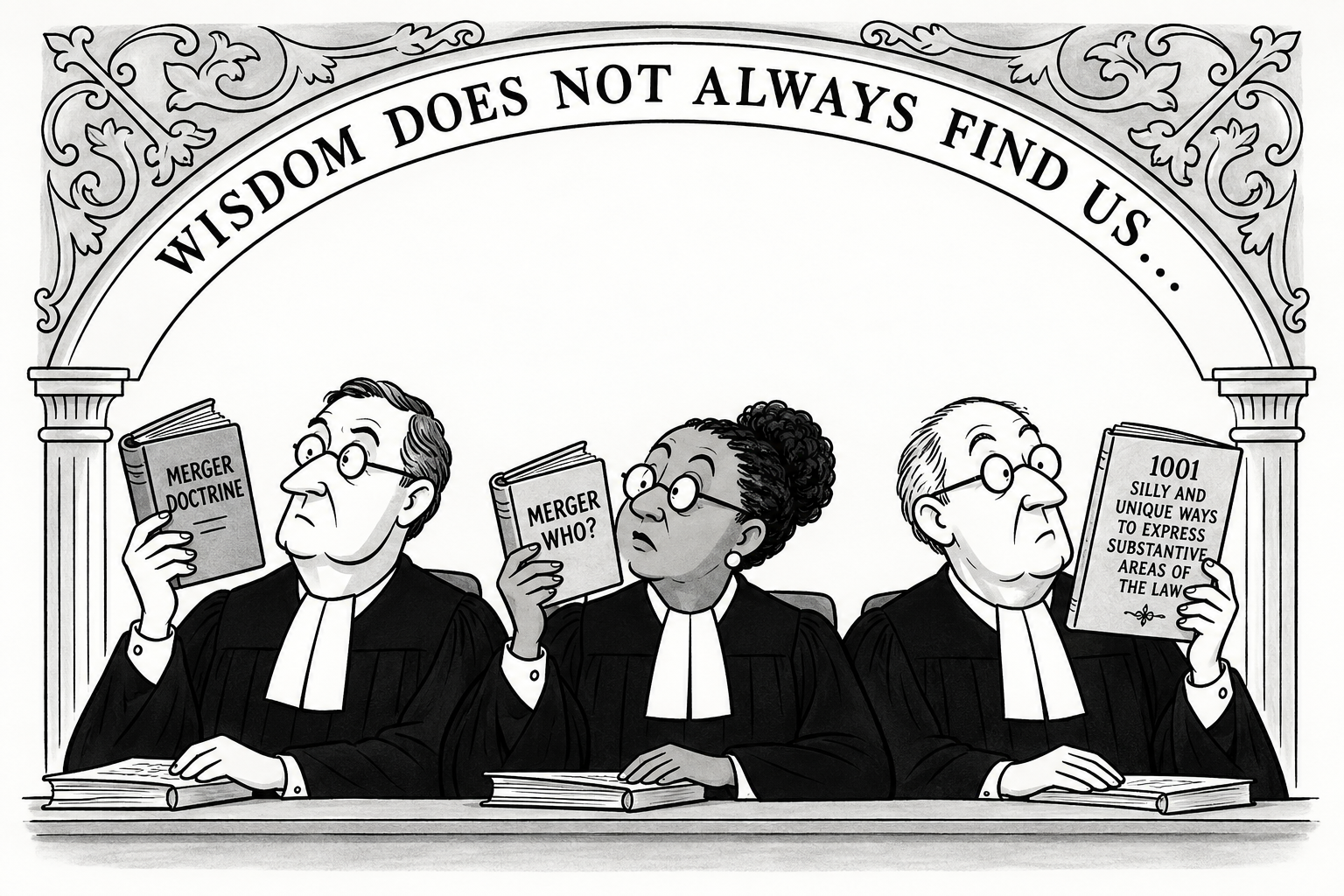
ROSS argued that headnotes merge with the points of law they state. The court disposed of this in a single conclusory paragraph. It described merger as limited to the “rare” case in which “a work’s underlying idea can effectively be expressed in only one” or a “few . . . ways” (Ross COA Opinion, p. 12). It then compared headnotes to a banana costume: “just as a banana costume can take myriad designs, so too can headnotes have differing expressions…So the merger doctrine does not apply.” (Ross COA Opinion, p. 12).
This is the part of the opinion that really rankles. Merger is a copyright law doctrine under which courts will not enforce copyright in expression when the underlying idea can be expressed in only one way or a small number of ways, because protecting the expression would effectively protect the idea. It has been recognized in many cases.
To give one example, we see merger articulated well by the First Circuit in Morrissey v. Procter & Gamble, a dispute over the rules for a sweepstakes contest. The court acknowledged that the record showed “there was more than one way of expressing even this simple substance” (Morrissey at 678). It applied merger anyway: “When the uncopyrightable subject matter is very narrow, so that ‘the topic necessarily requires,’ if not only one form of expression, at best only a limited number, to permit copyrighting would mean that a party or parties, by copyrighting a mere handful of forms, could exhaust all possibilities of future use of the substance” (Morrissey, 379 F.2d at 678–79). The court added that merger does not wait until every alternative form has been claimed. As it put it, “We cannot recognize copyright as a game of chess in which the public can be checkmated” (Morrissey at 679). [Note: we especially like this evocative way of expressing what the public loses when merger is ignored]
The en banc Fifth Circuit faced the same “many ways” argument in Veeck v. Southern Building Code Congress International. The code-writing organization argued that merger could not apply because there are “many possible ways to express model codes” (Veeck at 802). The court rejected that argument:
“What SBCCI and the dissent ignore, however, is the graphic merger of its model building codes with “the law” as enacted by Anna and Savoy, Texas. Veeck copied from SBCCI’s model codes, 1994 edition, because those codes were transformed into the “fact” and “idea” of the towns’ building codes. Veeck could not express the enacted law in any other way.” (Veeck at 802).
The bare possibility of other phrasings, variations, ways of expressing something proves nothing. It is true of everything. I could rewrite every headnote in Westlaw as a limerick, or as a sonnet, or in Pig Latin. If that defeated merger, the doctrine would never apply to anything. Where the subject matter permits only a limited range of usable expression, protecting a handful of forms would hand over the substance itself. The question is not how many expressions are conceivable (answer: near limitless variations, for everything). It is how many remain once the expression has to do the job it is meant to do, without becoming something else entirely.
The opinion describes the constraints that should help us answer that question. Headnote editors must state a point of law accurately, include only essential facts, stay within 800 characters (note from us: this is usually less than 200 words) where possible, and “[g]enerally . . . follow the court’s language” (Ross COA Opinion, p. 4). When combined with the legally precise nature of headnotes, those are the conditions under which expression will virtually always merge with the idea.
Yet the court counted compliance with those same constraints as the creative spark, crediting editors’ choices about “how to word those points of law consistent with Westlaw’s drafting criteria” (Ross COA Opinion, p. 10) (“For each headnote, Thomson Reuters’s editors made creative decisions about which points of law were important enough to include in a headnote and how to word those points of law consistent with Westlaw’s drafting criteria.”)
The banana costume is not similar. Costume design is about as unconstrained as expression gets: shape, color, texture, and material are all free choices. A headnote’s entire function is to restate a rule of law faithfully. The practical result of the court’s approach is that copyright attaches to the formulations that closely approximate the law itself, and anyone trying to state concisely and accurately what a passage holds will find their language drifting toward what a headnote already says.
In reading this court’s opinion, it’s very hard to come up with what remains of merger doctrine in the Third Circuit.
Fair use: comparing businesses instead of uses
The court framed the first factor as a comparison of platforms. Because “both Thomson Reuters and ROSS use the headnotes to create and optimize a legal-research platform that helps users find responsive legal material,” ROSS’s use “shares the same ultimate purpose” and is “minimally transformative, at best” (Ross COA Opinion, pp. 16–17).
This is the conflation of users and uses we warned against in our amicus brief. Warhol asks whether the particular use of the work serves a purpose distinct from the work’s own. Westlaw’s headnotes exist to be read by researchers. ROSS’s copies were never read by its users at all; they served as labeled examples teaching a model what a responsive passage looks like. The court conceded that training was “an intermediate step” that “arguably presents a slight degree of difference in use,” then moved on (Ross COA Opinion, p. 16). And in distinguishing Authors Guild v. Google, it stressed that Google’s search might lead readers to buy books while ROSS aimed to replace Westlaw (Ross COA Opinion, p. 19), a market-substitution point borrowed from factor four.
Regarding intermediate copying, the court read Sega, Connectix, and Google v. Oracle as cases in which “copying was necessary to access the unprotected functional aspects of computer code” (Ross COA Opinion, p. 20). Because ROSS could have worked from the opinions, the court held that “[u]nlike necessity, ease is not a justification for copying” (Ross COA Opinion, p. 21).
But transformative use has never required that copying be the only route to a purpose. And the opinion does not engage the non-software intermediate copying cases we and others raised. Taken seriously, a necessity requirement would cast doubt on ordinary research practice: a scholar who builds on an existing annotated corpus rather than re-annotating thousands of documents is also choosing ease and/or efficiency.
The necessity reasoning returns under factor three: “Copying the headnotes was also not necessary to train ROSS’s AI, as the underlying judicial opinions were freely available” (Ross COA Opinion, p. 23). The court also held that each headnote is its own work, so “for each headnote taken, ROSS copied an entire work” (Ross COA Opinion, p. 23 n.10). Combined with a low originality bar for short summaries, this ensures factor three will cut against almost any use of abstracts, annotations, or summaries. (The opinion also says ROSS copied “the entire text of the 25,000 Westlaw-written headnotes” (Ross COA Opinion, p. 22), though the judgment it affirms covers 2,243 headnotes that memo questions were found to closely resemble.)
Finally, in analyzing market effect, the court accepted a derivative market in AI training data: “the evidence shows that the market for licensing headnotes as text to train AI is rapidly developing,” and “[t]hat Thomson Reuters did not license its headnotes to others does not disprove that a market exists to do so” (Ross COA Opinion, p. 26). The opinion cites nothing in the record for the first proposition. It never addresses the circularity problem the Supreme Court flagged in Oracle and that other decisions guard against: every rightsholder loses a licensing fee if the relevant market is defined as the market for licensing the very use at issue. The court also treated the headnotes’ “value as a draw for users” of Westlaw as cognizable (Ross COA Opinion, p. 25), which incorrectly lets the platform’s market stand in for the work’s.
What this decision means, and what might come next
The ruling binds federal courts in Pennsylvania, New Jersey, Delaware, and the Virgin Islands, and as the first appellate word on AI training it will be cited in many pending and future cases by plaintiffs in AI suits. We are hopeful that its reach and impact will ultimately be quite limited. The court leaned heavily on undisputed facts that ROSS was commercial, priced itself against Westlaw, and set out to replace it. Noncommercial researchers who do not compete with their sources remain on firmer ground, and footnote 7 makes some effort to distance this case from the generative AI cases.
Still, the opinion hands litigants a set of perniciously pernicious tools. Rightsholders will cite its acceptance of an unlicensed, thinly evidenced AI training market. Its necessity framing invites the argument that copying is unjustified whenever a defendant could, with more effort, have done without it. And its merger analysis, paired with treating each short summary as a standalone work, strengthens claims over abstracts, annotations, and other thin works whose value lies in stating facts and ideas accurately.
So what comes next? ROSS may seek rehearing en banc or certiorari to the Supreme Court. The odds of either seem low to us: the case comes up with facts that diverge from most other AI cases, ROSS is no longer operating, and no other circuit has ruled on AI training. The likelier path to the Supreme Court comes through the generative AI cases pending in the Second and Ninth Circuits.
That said, this opinion represents several deformations of copyright law, and if other courts follow it, the Supreme Court will need to correct the damage.
Discover more from Authors Alliance
Subscribe to get the latest posts sent to your email.