Releasing The Public Interest Corpus Principles and Goals
Today, we are pleased to release The Public Interest Corpus Principles and Goals. This release builds on the recap of […]
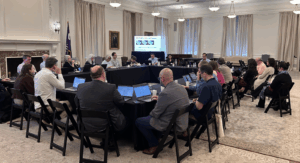
The Public Interest Corpus recently completed the last of three planning workshops. The final workshop was hosted at the University
Open access publishing has transformed the way research circulates. In principle, open access means that anyone, anywhere, can read and reuse scholarly work without financial, legal, or technical barriers. But in practice, many works labeled as “open” are quietly constrained by restrictions that limit how they can be used, especially by machines.
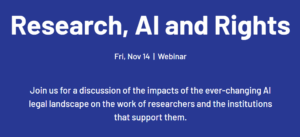
This is the second of five webinars in our Fall Discussion Series in collaboration with OCEAN. Join us for a discussion of the impacts of the ever-changing AI legal landscape on the work of researchers and the institutions that support them. Rachael Samberg will walk us through how the latest litigation affects research activities, such as text data mining, how researchers can utilize fair use to address these issues, and other considerations, such as research integrity and liability, and privacy considerations.
This is a post by Syn Ong, AI Policy Researcher at Authors Alliance. Authors increasingly rely on text and data mining (TDM) to analyze large corpora across disciplines. Our new working paper, Beyond the Exception: Licensing, Access, and the Realities of Text and Data Mining in the US, UK, and Singapore, finds that formal legal permissions alone do not secure usable access for TDM research. Instead, usable access turns on how statutory rules interact with private licenses, platform architectures, and technological protection measures (TPMs).
We’ve written before about the use of contracts limiting author’s access to fair use, including how publisher contracts restrict innovation
Last month, a diverse set of stakeholders gathered at New York University Law School to contribute to an implementation plan
Yesterday, Authors Alliance filed an amicus brief, joined by EFF, ARL, ALA, and Public Knowledge, with the 9th Circuit in
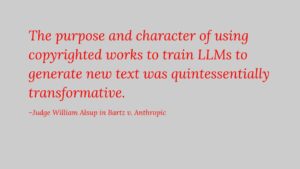
Yesterday, Judge Alsup released his decision on Anthropic’s motion for summary judgment in the fast-moving lawsuit it is defending, brought
Our law student intern this semester studied the legal and practical challenges facing TDM researchers. She shares her key takeaways.