
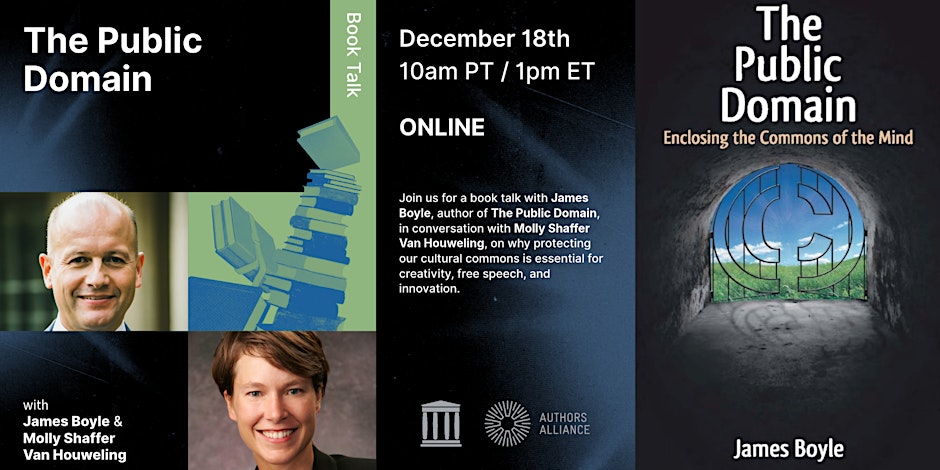
Virtual; Thursday, December 18, 2025 at 1pm ET
This event has passed. Watch the recording HERE.
Join James Boyle with Molly Shaffer Van Houweling on why protecting our cultural commons is essential for creativity and innovation.
Why the public domain is vitally important and what we must do to protect it
In this enlightening book James Boyle describes what he calls the range wars of the information age—today’s heated battles over intellectual property. Boyle argues that just as every informed citizen needs to know at least something about the environment or civil rights, every citizen should also understand intellectual property law. Why? Because intellectual property rights mark out the ground rules of the information society, and today’s policies are unbalanced, unsupported by evidence, and often detrimental to cultural access, free speech, digital creativity, and scientific innovation.
Boyle identifies as a major problem the widespread failure to understand the importance of the public domain—the realm of material that everyone is free to use and share without permission or fee. The public domain is as vital to innovation and culture as the realm of material protected by intellectual property rights, he asserts, and he calls for a movement akin to the environmental movement to preserve it. With a clear analysis of issues ranging from Jefferson’s philosophy of innovation to musical sampling, synthetic biology and Internet file sharing, this timely book brings a positive new perspective to important cultural and legal debates. If we continue to enclose the “commons of the mind,” Boyle argues, we will all be the poorer.
ABOUT OUR SPEAKERS
James Boyle is William Neal Reynolds Professor of Law, Duke University School of Law. He lives in Chapel Hill, NC.
Molly Shaffer Van Houweling joined the Berkeley Law faculty in fall 2005 from the University of Michigan Law School, where she had been an assistant professor since 2002. Van Houweling’s teaching and research interests include intellectual property, law and technology, property, and food law.
Discover more from Authors Alliance
Subscribe to get the latest posts sent to your email.