
Authors Alliance submitted a comment to the US Copyright Office in response to its proposed fee schedule (Docket No. 2026–2). We focus our comment on two things: (1) commending the Office for imposing heavier fee increases on corporate users—such as those registering large photographic and non-photographic databases, and (2) urging the Office to stay true to its stated policy goals of incentivizing creativity by not hiking up the price of recording termination notice.
Copyright termination of transfer is a statutory right under Section 203 and Section 304 of the 1976 Copyright Act. It allows authors to reclaim ownership of works they previously signed away. When a novelist or academic writer transfers their copyright to a publisher, that transfer isn’t permanent. After a waiting period of 35 years, the author can serve a termination notice and take back the rights, regardless of what the original contract says. The right is inalienable, meaning no contract clause can waive it in advance. Congress built it that way deliberately, recognizing that creators often negotiate from a weaker position compared to the distributor. Termination gives authors a chance to license on better terms, or simply reclaim control over work that is central to their creative legacy.
Recording the termination notice with the Copyright Office is the formal step that is required to make termination legally effective (See our step-by-step guide on how to file a termination notice). That is why the fee the Office charges authors to do so matters enormously to the human authors.
We flag three key problems with the proposed fee for recording termination notice:
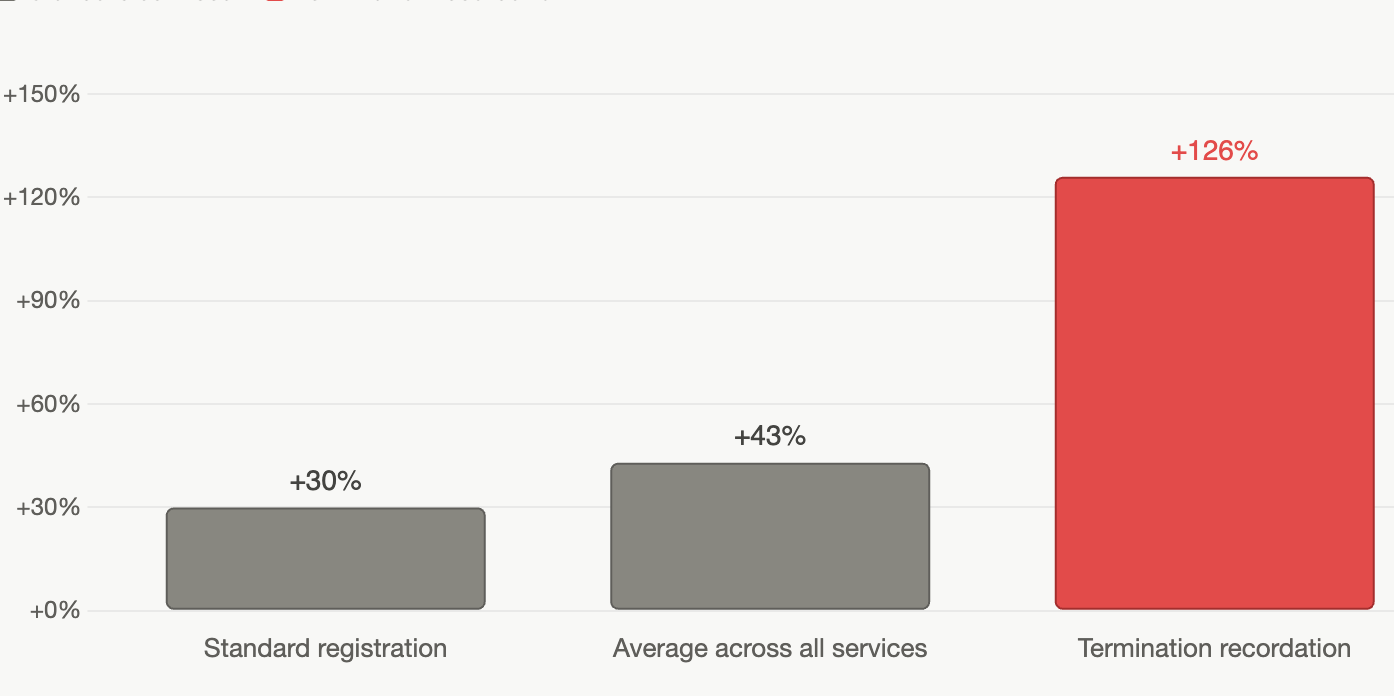
First, we point out the fee for recording termination is proposed to increase a staggering 126%, compared to the “average of 43%” increase in all registration and recordation services. We urge the Office to cap the fee increase for recording termination notice to the “average of 43%” increase in its services, making the fee for recording termination notice no more than $135.85 for electronic and $178.75 for paper. We also urge the Office to consider the possibility of further limiting the fee increase to account for the fact that many authors are already priced out of exercising termination rights.
Second, we point out that recording termination notices require 8.5x the expenditure in staff training and similar expenses as registering a new copyright. For comparison, registration entails labor-intensive review by trained professionals, yet standard registration for a literary work with e-deposits—the most costly category of work out of all standard registrations—has a direct cost of $21.37 and indirect cost of $125.14 per registration, or $146.52 in total. Yet recording termination notice is reported to incur a direct cost of $95.68 and indirect cost of $1,006.88, totaling $1,102.56 for each electronic submission. We ask the Office for clarification.
Third, we point out it is not clarified if counter-notice processing costs are being folded into the fee for recording termination notice, and whether authors alone are made to bear those costs. We do not think the Office should ask authors to bear the cost of processing counter-notices. Termination was introduced by Congress as a more powerful safeguard for authors than the renewal system that existed before; therefore it should never be made financially more burdensome to exercise. Furthermore, intermediaries are incentivized to oppose termination notice even without the counter-notice fee exemption.
The Office is also soliciting comments on a new fee structure. We encourage you to share your ideas with the Office.
Discover more from Authors Alliance
Subscribe to get the latest posts sent to your email.