
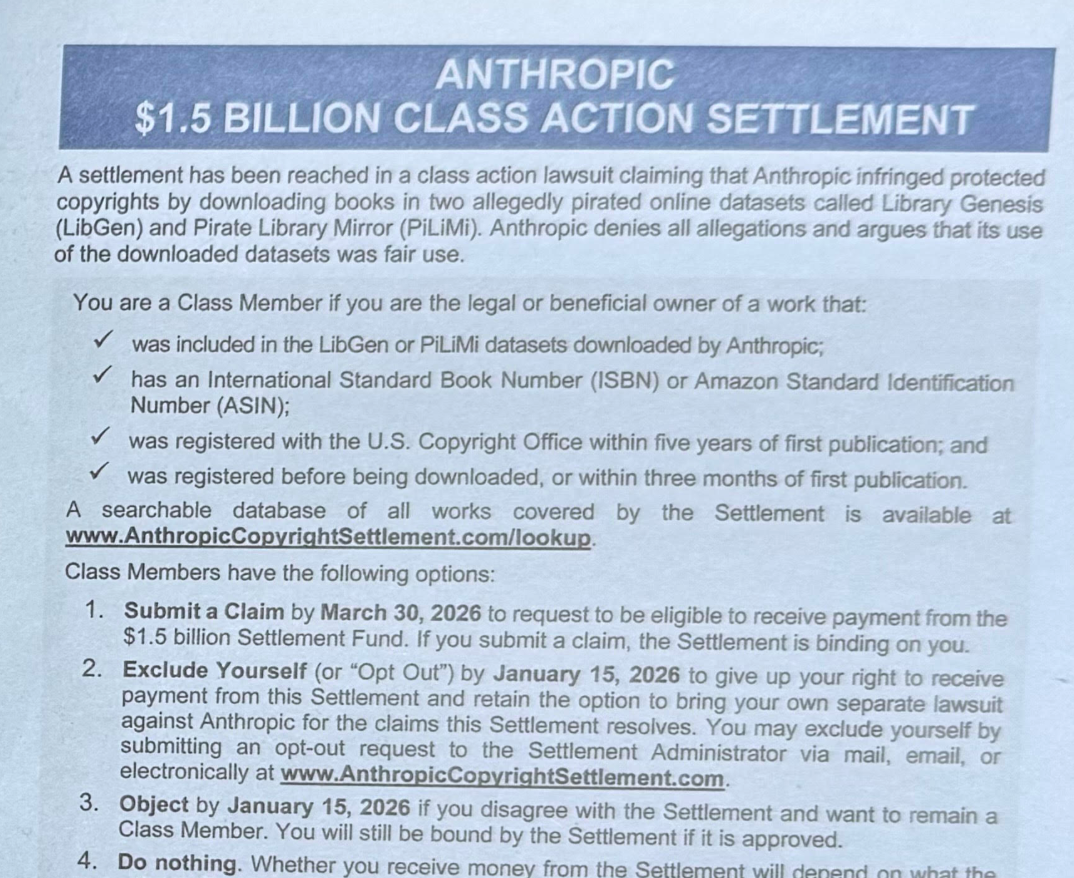
The fairness hearing in Bartz v. Anthropic is set for today, Thursday, May 14, 2026, at 2:00 p.m. Pacific Time before Judge Araceli Martínez-Olguín. The hearing will be open to the public via Zoom. The order recommends logging in early to avoid any capacity or connectivity issues.
Two developments to note before the hearing:
- The claims rate is now 91.3%. In an updated claims report filed April 16, Class Counsel reported claims for 440,490 of the 482,460 works on the Works List (Dkt. 643), up from the 54% reported in the March 19 motion for final approval. Note, however, that we really don’t know what percentage of authors or publishers implicated in the suit responded. Because some large publishers hold rights in tens of thousands of works (and presumably those publishers are aware of the suit and made claims) the actual percentage of claimants responding is likely more modest than the percentage of works claimed).
- Class Counsel has filed a Proposed Order asking the Court to grant final approval and overrule all objections (Dkt. 646-1; full docket here). The proposed order revises Class Counsel’s fee request downward from 15% to 12.5% of the $1.5 billion settlement fund, plus approximately $3 million in incurred expenses, an $18.22 million cost reserve, and $50,000 service awards to each of the three class representatives. (Proposed order at 12)
See our previous post for background on the types of objections we are likely to hear at the fairness hearing.
What Class Counsel Asks the Court to Do in the Proposed Order
The Proposed Order is a category-by-category roadmap for how Class Counsel would like the court to dispose of objections to the settlement. Whether the court decides to follow this roadmap is an entirely different question, and this hearing will likely help us better understand the likelihood of that outcome. Here are some, but not all, of the elements in the Proposed Order:
- Objections from non-class members are stricken for lack of standing. If the proposed order is followed, this captures most objections arguing the Works List is underinclusive, that particular books should be in the class but aren’t because of the ISBN/ASIN requirement, the U.S. registration requirement, the registration-timing requirement, or because Class Counsel failed to identify them. (See Proposed Order at 8)
- The notice campaign is defended as adequate, citing the 56-day direct notice period reaching to 99.5% of identified rightsholders. Objections that the notice steered class members toward filing claims rather than opting out are disputed (“As to content, the Court-approved Notice expressly stated that statutory damages could range from $200 to $150,000 per Work, and gave “equal dignity” to the options of filing a claim and opting out.”). (Proposed Order, 7-8)
- Late opt-outs are denied with two exceptions. Laura Esquivel and her nephew Jordi Castells, which are denied without prejudice on the ground that they have not shown the consent of other legal or beneficial owners of the six works at issue (“For this reason, Esquivel’s and Castells’s untimely opt-out requests are DENIED without prejudice”) (Proposed Order at 12).
New Replies on the Docket
Several objectors have filed replies challenging Class Counsel’s characterization of their objections. Here’s a sampling:
Victoria Pinder (Dkt. 648) raises an issue with how payouts work across works registered as a group. Pinder is the author of 40+ independently published novels that she registered under a single, lawful group copyright registration. Under the settlement, each copyright registration number counts as one “claimable Work.” An author who registered 40 books individually would receive 40 shares; Pinder receives one — for the same number of distinct books, each separately used by Anthropic, each with its own ISBN or ASIN. She reports that when she raised this with Class Counsel, she was told that counting her individually published books separately could constitute a “windfall.” Class Counsel’s proposed order does not engage with the group-registration question on the merits; it responds that “any author or publisher can register their work on an individual basis,” which Pinder argues is non-responsive.
Chinonto Chakanga (Dkt. 649) argues that Class Counsel’s reliance on Judge Alsup’s notice-remediation orders stands in contrast to what those orders actually say. On Chakanga’s reading, those orders document Judge Alsup’s findings that the original notice was engineered to steer class members away from opting out. Judge Alsup “commanded” equal dignity going forward but did not find it had been achieved. Chakanga also raises a separate due process argument: thousands of pages of sealed summary judgment records, class certification briefs, and expert declarations were not unsealed until January 21, 2026, eight days before the original opt-out deadline and 19 days before the extended deadline. Citing the Ninth Circuit’s recent decision in Avery v. TEKsystems (January 28, 2026), Chakanga argues that compressed timing during the holiday period combined with a sealed judicial record is a substantive defect in the opt-out process.
Laura Esquivel (Dkt. 651), the Mexican author of Como agua para chocolate, challenges Class Counsel’s novel “co-owner consent” requirement for her late opt-out. As her reply notes, the Long Form Notice expressly provides that a single rightsholder’s decision to opt out binds co-authors and publishers; the settlement framework treats opt-out as a unilateral right, not one requiring co-owner consent. Esquivel also argues she meets the Pioneer excusable-neglect standard: she did not receive notice until March 3, 2026 (three weeks after the deadline); she lives in Mexico and reads Spanish, but no Spanish-language notice was provided; and she suffered a stroke during the relevant period.
A Reminder of the Stakes for Authors
For context on what is at stake at the per-author level, the objection filed in January by James Sills (Dkt. 600), reported that Elsevier proposed to take 88% of the per-work settlement amount for one of his books, leaving 12% for the author. The settlement’s default split for non-education works is 50/50, but education works (including textbooks) are subject to negotiation and arbitration governed by the Special Master process.
We do not yet know how representative Sills’s experience is across the author class. But Professor Lea Bishop’s intraclass fairness objection (Dkt. 602) raises the related structural concern that the settlement’s allocation framework, including a Special Master whose career was built representing publishers, forfeiture of unclaimed author funds that will go, in part, to publishers, and the absence of class-counsel assistance to authors in publisher splits, systematically advantages publishers in what is described as a “zero-sum exercise” between authors and publishers for each work. (Objection at 2)
If the Sills 12/88 split turns out to be common among textbook authors negotiating with major academic publishers, the practical recovery for many education-class authors will look very different from the $3,000-per-work figure that has been widely reported in the press.
Attending the Hearing
The fairness hearing is at 2:00 p.m. Pacific Time on Thursday, May 14. Anyone interested in following this litigation is encouraged to attend. Public access details are in the court’s order; again, we recommend trying to log in early.
Post-Hearing Updates
We will provide an update to this post with observations and key takeaways from the fairness hearing as soon as we are able.
Discover more from Authors Alliance
Subscribe to get the latest posts sent to your email.