
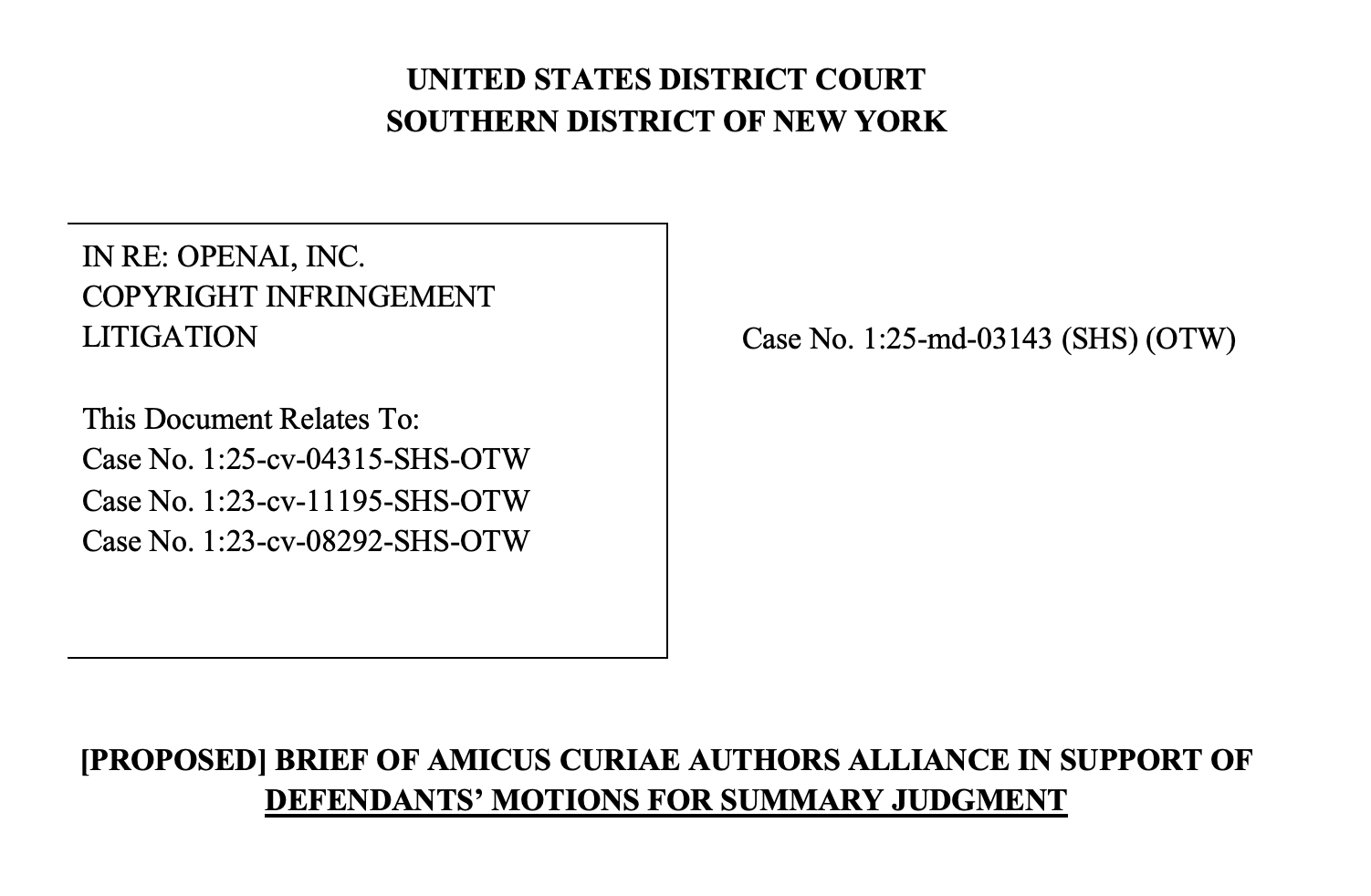
On October 29, Authors Alliance asked the court for leave to file an amicus brief in In re OpenAI, Inc. Copyright Infringement Litigation, the consolidated copyright lawsuits against OpenAI and Microsoft pending in federal court in New York. Our brief supports the defendants’ motions for summary judgment, but focuses onone issue only: whether “market dilution” is a kind of harm that copyright law recognizes. We argue that it is not, and that treating it as one would end up hurting many of the authors the theory claims to protect.
In Re: OpenAI, Inc. Copyright Infringement Litigation
This multidistrict litigation brings together a long list of lawsuits against OpenAI and Microsoft, filed by book authors (including the Authors Guild and a proposed class of authors) and by news organizations such as The New York Times, Daily News, and Ziff Davis. The cases were consolidated before Judge Sidney Stein in the Southern District of New York. The plaintiffs argue that copying their works to train OpenAI’s models was infringement. OpenAI argues that the training was fair use.
The parties filed cross-motions for summary judgment this fall, asking the court to resolve most of the major questions in the suit based on (mostly) undisputed facts that emerged during discovery. Oppositions from the parties came in on October 23. Amicus briefs from other interested parties are due today. A number of organizations and individuals on both sides have already filed briefs representing a wide variety of views, and we expect more to be filed in the coming days.
Authors Alliance’s Brief
Our brief focuses on a single issue: “market dilution,” which is the idea that copying works to train an AI model harms the market for those works because the model can then generate new works that compete with them, even if none of those new works reproduce protected expression from the original and are not infringing. The theory comes from Judge Chhabria’s 2025 decision in Kadrey v. Meta, which acknowledged it had never made a difference in a case before. Judge Alsup rejected a similar argument in Bartz v. Anthropic, and the Copyright Office floated a version of it in its pre-publication report on AI training. The class plaintiffs in this case have asked Judge Stein to adopt it.
The economic premise behind the theory of “market dilution” may, in some sense, be true. In the abstract, a flood of new books in a genre could make it harder for any one of them to find readers. But, as our brief explains:
[C]opyright law has never treated every economic effect of a new expression as a copyright injury. Copyright gives authors control over the market for their protected expression. It does not give them a right to be free from competition by works that borrow only the ideas, facts, genres, and methods that remain free to all.
The brief gives four reasons the court should reject the theory:
First, market dilution is ordinary competition: factor four reaches uses that substitute for protected expression, not new works that compete for the same readers. Second, neither Defendants’ burden of proof nor the scale of generative AI changes the kind of harm the statute recognizes. Third, the theory would protect the ideas, facts, and genres that § 102(b) and the Constitution leave free. Fourth, it would fall hardest on authors who build on earlier works, as scholars, critics, and biographers routinely do.
Scale is where supporters of the theory place most of their weight, arguing essentially that AI is different because it can make so many new works. Our brief takes this on directly:
That is competition at scale, not substitution at scale. Multiplying the number of noninfringing competitors does not change the nature of the injury; a thousand new romance novels that take nothing protectable from a plaintiff’s book inflict no more cognizable harm than one does. Scale can magnify a harm that copyright recognizes, but it cannot create one where none exists.
We take no position on the other questions in the case, such as how OpenAI acquired its training data or whether particular model outputs infringe.
Why This Matters for Authors
The plaintiffs present this case as one about the interests of authors generally, and many of our own members’ books were used to train the models at issue. But as we put it in the brief:
Authors are both copyright holders and users. A rule broad enough to protect an incumbent author from noninfringing AI-generated competition is broad enough in principle to protect an incumbent author from noninfringing human competition that fair use helped enable.
New scholarship and open textbooks often succeed precisely by displacing the works they build on. And authors have always learned by copying. For example, Hunter S. Thompson retyped pages of The Great Gatsby to get a feel for Fitzgerald’s prose, and no one would say Fear and Loathing in Las Vegas injured Fitzgerald’s copyright.
It may be tempting to regard market dilution as an AI-specific response to an AI-specific problem of scale. But a legal rule does not stay attached to the technology that prompted it.
If the theory takes hold, the parties best positioned to use it will be large rightsholders with deep catalogs and the resources to hire market experts. The cost will fall on individual authors and smaller publishers who rely on fair use and would have to disprove speculative theories about how the market would have looked without them.
You can read our full brief here.
Discover more from Authors Alliance
Subscribe to get the latest posts sent to your email.