
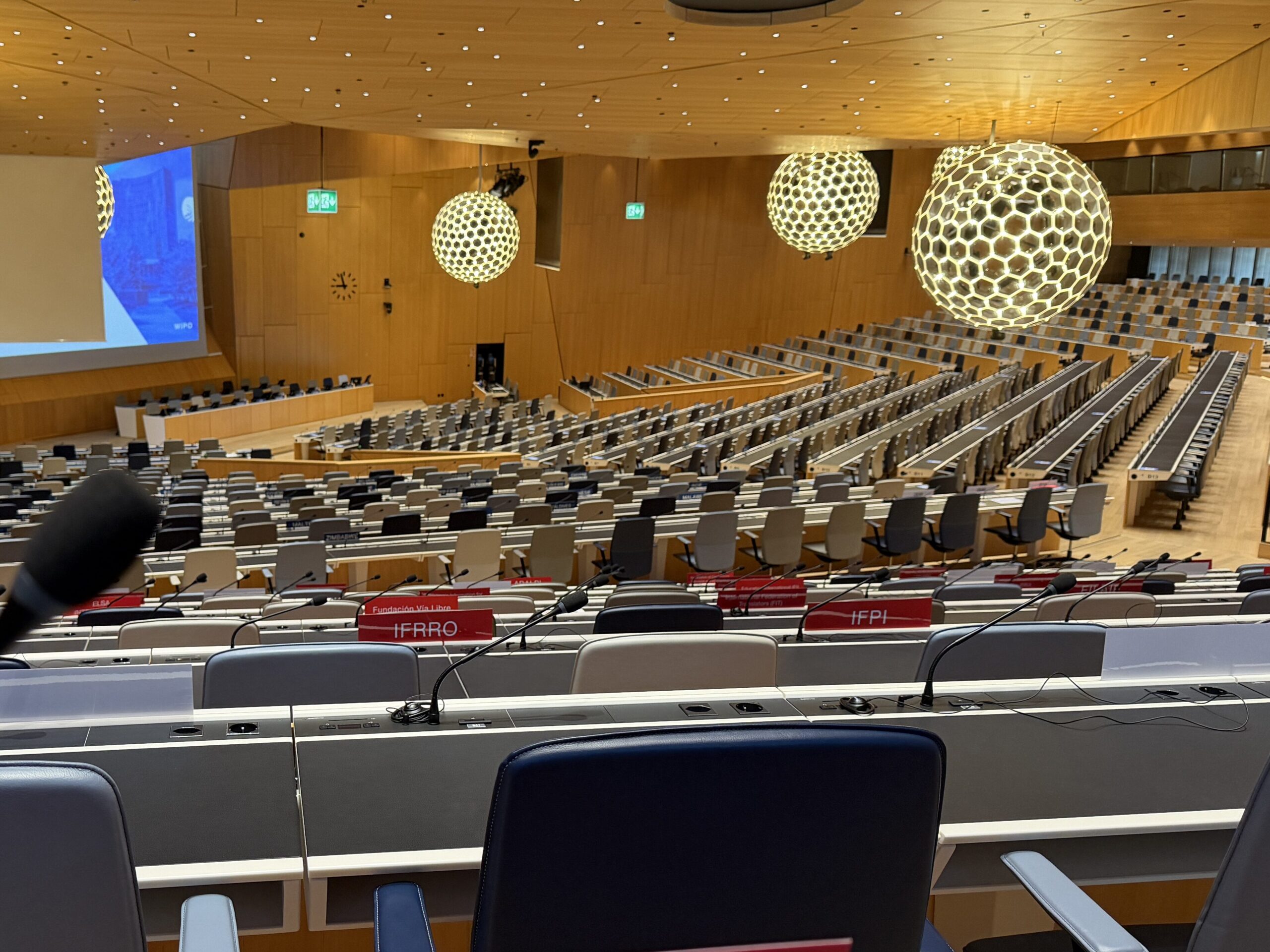
(photo: Eric Harbeson, CC-BY)
This post is part of our series of posts marking the 50th anniversary of the Copyright Act of 1976. To find a list of all the posts in this series, including guest posts, click here. This is a guest post by Katherine Klosek, Director of Information Policy and Federal Relations at the Association of Research Libraries (ARL), in anticipation of the 49th meeting of WIPO’s Standing Committee on Copyright and Related Rights.
The agenda for the upcoming meeting of the World Intellectual Property Organization (WIPO) Standing Committee on Copyright and Related Rights (SCCR), SCCR 49 (November 30 to December 4, 2026), includes a discussion on enabling the facilitation of access to published works in accessible formats for persons with disabilities other than those covered by the Marrakesh Treaty. This post explains the potential implications for US copyright law if this discussion eventually leads to a treaty or other binding document (or “instrument” in WIPO-speak).
The Chafee Amendment and the Marrakesh Treaty
In the 1976 Copyright Act, fair use was the main exception that libraries could use to create accessible copies. It wasn’t until 1996, when Senator Chafee introduced an amendment to “end the unintended censorship of blind students’ access to current information,” that the Act included a specific, explicit allowance for accessibility. The so-called “Chafee Amendment,” codified in section 121 of the Copyright Act, permitted entities that provided services to people with print disabilities to make copies in accessible formats. While Section 121 is limited to those specific categories, fair use is a broader right, and courts have affirmed (most notably in Authors Guild v. HathiTrust) that libraries and other authorized entities can rely on it to create accessible copies outside of the categories outlined in Chafee.
Since at least 2010, the caucus of African countries in WIPO (called the “African Group”) have proposed a WIPO Treaty with limitations and exceptions for persons with disabilities. The African Group’s proposals were instrumental in what became the 2013 Marrakesh Treaty to Facilitate Access to Published Works for Persons who are Blind, Visually Impaired or Otherwise Print Disabled, which provides for the cross-border exchange of accessible format-works. Under the Marrakesh Treaty, countries that join the Treaty are obligated to amend their copyright law to adopt Chafee-like exceptions, as well as provisions allowing for the international import and export of accessible format copies. The Treaty also requires countries to ensure that laws prohibiting circumventing technological protection measures (TPMs) do not prevent beneficiaries from enjoying the Treaty’s exceptions.
Congress passed the Marrakesh Treaty Implementation Act (MTIA) in 2018, which amended Section 121 of the Copyright Act to conform with the obligations of the Treaty, and created a new Section 121A that permits the import and export of copies in accessible formats.
The African Group’s Proposal
In 2022, the African Group proposed a Work Program on Limitations and Exceptions, to build on earlier work in this area to include people with disabilities as defined more broadly, beyond just visual impairment. The SCCR adopted the work program in 2023, and later that year the African Group proposed a specific draft instrument based on previous proposals (SCCR/47/5).
The African Group’s proposed language declares in Article 6 that:
“It shall be permissible to produce, distribute, and make available accessible format copies of works for the benefit of people with any disability that requires such format to enjoy the work on an equitable basis with others.”
The phrase “any disability,” combined with a preamble noting that the Marrakesh Treaty does not apply to people with non-visual disabilities, demonstrates a clear intent to extend coverage beyond visual and print disabilities. The African Group’s proposal would apply to published and unpublished works in any format. However, the chair’s text (the working language used in negotiation) refers only to “published works.”
The language proposed by the African Group integrates exceptions for people with disabilities into a larger proposal for limitations and exceptions for education, research, and the public interest. For instance, Article 3 of the proposal lists facilitating “access for persons with disabilities” alongside other public interest goals including education, research, freedom of expression, access to information and news reporting, and preservation of cultural heritage. Article 4 names “making and providing accessible format copies of works to teachers, students, or researchers with disabilities, including by import and export” as a permitted use in the course of creating educational materials. Article 7 adds Marrakesh-like provisions permitting the cross-border exchange of copies that are lawfully made under a limitation or exception.
The rights in the proposed instrument are reinforced by Article 9, which renders unenforceable any contractual provision that would restrict the limitations and exceptions, and Article 10, which requires that technological protection measures not prohibit the uses enabled by the limitations and exceptions.
Article 12 provides that nothing prevents countries from interpreting the “three-step test” (an international copyright standard present in the Berne Convention and other agreements) in a manner that respects legitimate interests, including education and research needs, human rights and fundamental freedoms, and other public interests. ARL takes the position that such an interpretation should surely consider the rights of people with disabilities, in line with the integration of people with disabilities in sections on the public interest, research, and education.
Progress at WIPO
In advance of SCCR 48 in 2026, the Association of Research Libraries (ARL) and the Canadian Association of Research Libraries (CARL) joined a letter by the Access to Knowledge Coalition encouraging the SCCR to treat the African Group’s proposal as the base text for further discussions. Other, arguably competing proposals were introduced in 2025, including a text proposed in the framework of work toward an international instrument (SCCR/47/8) and updated versions of the “objectives and principles” documents for educational, teaching, and research institutions (SCCR/47/9), and for libraries and archives (SCCR/47/10), but they were not as comprehensive as the African Group’s proposal.
All of this led up to the last SCCR meeting, in May of this year, at which the Chair committed to merging these proposals into a single, cohesive document that would kick off work toward an instrument addressing limitations and exceptions for people with non-visual disabilities, as well as for preservation and education. The resulting document (SCCR/49/5), released in October in advance of SCCR 49, draws in a complementary manner on the Work Program, the African Group’s text, and the updated objectives and principles documents.
The Chair’s document on the agenda for SCCR 49 draws on the 2025 African Group proposal and other texts introduced at previous SCCR meetings. Its definition of persons with disabilities is based on the United Nations Convention on the Rights of Persons with Disabilities, and includes “those who have long-term physical, mental, intellectual, or sensory impairments which, in interaction with various barriers, may hinder their full and effective participation in society on an equal basis with others.” It would enable access to published works in accessible formats “under appropriate conditions,” including use solely for the purpose of producing material in accessible formats, and respect for adequate and effective digital security measures. It also allows that access subject to remuneration, licensing, or other conditions may be considered.
The document is clear that it is intended to facilitate substantive discussion of the Committee, that it does not promote any specific type of legal instrument (i.e., a treaty, a model law, or some other form of non-binding “soft law”), and that it “is without prejudice to the legal nature and form of the outcome of this process.”
Implications of a Binding Instrument
The outcome of the discussion is uncertain, and a binding treaty is unlikely due to the slow pace of WIPO and likely opposition from the U.S. and other countries. If the SCCR were to adopt a binding treaty with exceptions for people with all disabilities, fair use would cover obligations in US copyright law. However, Congress would likely amend Section 121 so there would be no ambiguity about US compliance with a treaty. This section analyzes what those amendments could look like.
Section 121 is currently limited to “eligible persons,” defined as those who are blind, visually impaired, or people who cannot hold or read a book because of a physical disability. If adopted into a binding instrument, the phrase “any disability” in Article 6 of the African Group’s proposal, or the phrase “disabilities other than those covered by the Marrakesh Treaty” in the Chair’s document, could encourage Congress to expand this definition to include other categories of disabilities, e.g., hearing impairments, cognitive disabilities, or physical disabilities. Making copies accessible to people with these other disabilities is likely a fair use under 17 U.S.C. § 107, but explicitly extending the scope of section 121 to include these people would provide legal assurance.
Neither the Chair’s document nor the African Group’s draft instrument uses the term “authorized entity” when discussing who may make and supply accessible copies. The chair’s document is open-ended (“enables the facilitation of access…”). The draft instrument refers to educational and cultural heritage institutions throughout, but its disability provision (Article 6) does not say who may make accessible copies at all. If a final SCCR instrument followed suit, Section 121 could move away from its reliance on nonprofit or governmental organizations, potentially opening the door to individuals or commercial entities making accessible copies without fear of infringement liability, so long as they heed the “appropriate conditions” for facilitating access laid out in the chair’s document. It’s also worth noting the draft instrument’s protection for those acting in “good faith,” and its secondary-liability exemption for educational, research, and cultural heritage institutions (Article 11) could offer legal protections for libraries or schools if a user happens to misuse an accessible format copy. The Chair’s document likewise includes a principle that “good faith” should be considered when assessing the liability of institutions.
Under the African Group’s proposal, a country may authorize uses beyond the instrument’s purposes—access for people with disabilities beyond those covered by Marrakesh—if they are subject to adequate remuneration (Article 8), though the uses outlined in the instrument would not be conditioned on payment. In contrast, the Chair’s document suggests that countries could make access for people with other disabilities subject to remuneration, licensing, or other conditions. Section 121 is not subject to remuneration, and it is unlikely that the U.S. Congress would mandate a licensing or payment scheme; Congress did not choose to implement a remuneration provision in the 2018 Marrakesh Treaty Implementation Act. Rightsholders could point to the Chair’s language to argue that free accessible copies for people with other disabilities would undermine their own sales of accessible editions, and that payment is needed to prevent that. However, the vast evidence that accessible works are not commercially available undercuts this argument. A country could require a commercial availability check, which would address this hypothetical concern without requiring payment.
Currently, Section 121 applies only to published works. If the U.S. were to align with the African Group’s draft instrument, it might need to expand the scope of Section 121 to include unpublished materials. Then again, the chair’s document seems to limit the discussion to published works.
Finally, alignment with Articles 9 and 10 of the African Group’s draft proposal would require U.S. law to ensure that contracts cannot take away the right to make accessible copies, and that technological protection measures cannot legally block these permitted uses. These have no counterpart in the Chair’s document, though it is likely that similar provisions could be added into a draft instrument during a negotiation. I’ve written in the Journal of Copyright Education & Librarianship (JCEL) about how U.S. copyright law does not have a statutory provision ensuring that anti-circumvention rules don’t interfere with Marrakesh-enabled uses. Instead, people with disabilities have to rely on the unpredictable Digital Millennium Copyright Act (DMCA) triennial rulemaking process. ARL has advocated for Congress to amend Section 12o1 to explicitly permit circumvention of technical protection measures when necessary to make a work usable by a person with a disability. Nothing is stopping Congress from doing this today.
Discussion
I haven’t been to Geneva (or Marrakesh, for that matter), but I follow SCCR through the Access to Knowledge Coalition, and from what I understand Chair’s commitment to develop a single document drawing on previous texts is a promising breakthrough.
The current push to cover non-visual disabilities isn’t a new idea at WIPO. As discussed above, the African Group has advocated for limitations and exceptions for a broad range of disabilities for more than a decade.
At a November 2023 panel discussion at SCCR, “What does it take for Authorized Entities to use the Marrakesh Treaty?,” hosted by ARL and CARL, Library Copyright Alliance Counsel Jonathan Band argued that the Marrakesh Treaty “has worked so well that its principles should be expanded to the making and distribution of accessible copies for people with other disabilities, such as people with hearing disabilities.” Victoria Owen, Chair of the ARL/CARL Task Force on Marrakesh Treaty Implementation, described the larger aim of Marrakesh: people with disabilities should be able to access books and information without needing modifications or special accommodations, on the same timeline as everyone else. For libraries to be genuinely inclusive and barrier-free, they need to make works available in every format, for people with every kind of disability.
Clarifying copyright law to explicitly permit remediation and cross-border lending of copyrighted works is necessary and important. But remediation is a workaround for a publishing system that wasn’t built with accessibility in mind. What if U.S. law could compel the production of works in accessible formats from the start?
There is some movement in that direction. As libraries adapt to updated A.D.A. regulations, some are using licensing terms to move the scholarly publishing industry toward “born-accessible” publishing rather than after-the-fact remediation. The European Accessibility Act (EAA), which came into effect in 2025, requires ebooks to meet minimum accessibility standards, including screen reader interoperability and metadata on accessibility features. While obligations of A.D.A. Title II fall on state and local government entities, the EAA applies to publishers, e-commerce platforms, producers of e-readers, and others along the ebook supply chain. A comparable legal requirement in the US would bring us closer to what Senator Chafee was trying to achieve 30 years ago this year: ending “the unintended censorship of blind students’ access to current information.” Requirements for ebooks and other materials to be born accessible flip the paradigm of needing to seek permission to remediate, ensuring that accessibility is built in from the start, rather than as an afterthought.
Progress at WIPO is glacial. The African Group has strategically linked its support for a separate Broadcast Treaty to this disability-rights instrument, tying the two together to advance both agendas. But WIPO negotiations are built for consensus and are slow by nature. It’s possible that WIPO will be outpaced by other laws or technological advances brought by AI before an instrument is adopted. Further, there will be turnover in the role of SCCR chair, creating uncertainty as to the future of the chair’s document and any discussions that are based on it.
ARL is an observer at SCCR, and we will continue to track this and other updates while advocating for strong copyright law and policy for users.
Katherine Klosek can be reached at kklosek@arl.org | https://www.linkedin.com/in/kklosek/
Discover more from Authors Alliance
Subscribe to get the latest posts sent to your email.