
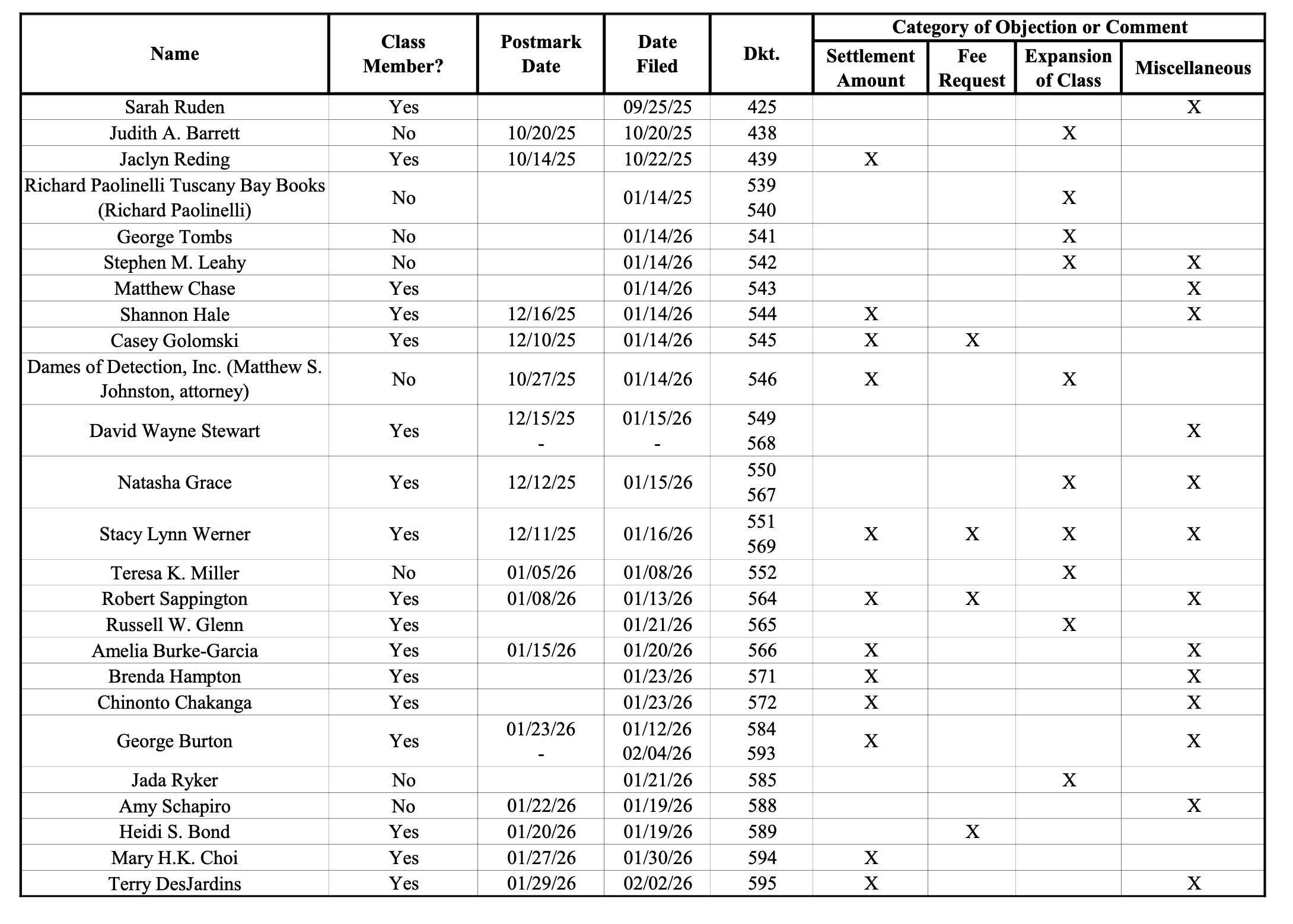
The fairness hearing in Bartz v. Anthropic took place this afternoon, Thursday, May 14, 2026, before Judge Araceli Martínez-Olguín in the Northern District of California. The hearing addressed approval of the $1.5 billion class action settlement, Class Counsel’s fee request, and the objections and replies filed by class members and others.
For background on the proposed order, the claims rate going into the hearing, and the principal objections, see our pre-hearing post.
The Court did not rule from the bench. Judge Martínez-Olguín indicated she would take the matter under submission and expects to issue short orders as soon as tomorrow. What follows are our preliminary observations.
Observations from the Hearing
The claims rate has continued to climb. Class Counsel reported that the claims rate, which stood at 91.3% as of the April 30 update, is now 92.77%. Counsel also stated that opt-outs remain modest: 350 valid opt-outs covering 1,802 works, with a handful of late opt-outs received after the deadline. Counsel has asked the Court to require those late filers to show a good reason for missing the deadline before their opt-outs are accepted.
Class Counsel framed the volume of “wrong class” objections as evidence of the settlement’s strength. A recurring theme in counsel’s presentation was that many objectors are not class members at all: they are authors and publishers who want their works included and are unhappy that their works were left off the works list for one reason or another. Counsel argued that this reflects how desirable inclusion in the settlement has become.
Objectors were given only two minutes each. That allocation noticeably constrained the presentations. The objectors who appeared raised, in compressed form, several of the arguments already developed in their written filings:
- Stacy Werner (attorney and author of seven books) argued that the settlement structure gives insufficient attention to independent authors and publishers, and raised the publisher’s failure to register copyright as a distinct issue.
- Victoria Pinder renewed her group-registration objection: four of her works appear on the Works List under a single group registration (TX0008716839), and she will receive a single share for what she describes as separately authored and separately used books.
- Matthew Chase focused on pseudonymous works, arguing that the Works List methodology fails authors who followed Copyright Office practice on pseudonyms and disadvantages self-published authors whose names do not cleanly match the list.
- Natasha Grace raised a similar group-registration issue and asked the Court to consider a remedial process by which authors who believe they have been wrongly excluded could submit their titles for inclusion.
- George Tombs objected to the ongoing use of the works, including the many unregistered works he believes were used in training but fall outside the class.
- Robert Jacobson argued that $3,000 is a small fraction of the $150,000 statutory ceiling and that the absence of information about how individual works were used in training makes proportional analysis impossible.
- Ramsey Hootman asked why a one-time payment is an appropriate resolution if Anthropic continues to profit from the works on an ongoing basis.
James Bartolomei, counsel appearing for objectors, made the argument that the notices about the settlement were insufficient because they didn’t include all relevant information. In particular, he argued that Judge Alsup’s fair use order was never made available to the class through the settlement website, and that the underlying summary judgment briefing was likewise absent. The fair use order is central to understanding the residual liability Anthropic faced — and therefore central to a class member’s decision whether to opt out or accept $3,000. Bartolomei requested a 35-day extension of time on that basis.
Judge Martínez-Olguín’s questioning focused heavily on the fee request and on expense accounting. Most of the bench’s questions concerned attorneys’ fees and the structure of the cost reserve, not the merits of the objections.
- On the service awards ($50,000 to each of the three named plaintiffs), Class Counsel justified them by pointing to the visibility of the case, the work undertaken by the named plaintiffs, and the absence of objections to the awards.
- On the cost reserve (a pool of settlement money set aside up front to cover ongoing costs of administering the settlement), the Judge pressed counsel on why expenses were being handled through a reserve rather than reimbursement, and signaled skepticism about money being administered outside the court’s view. Counsel pointed to Dkt. 619-1 for the cost detail, described a $15 million cap with the lion’s share going to ongoing administration, and represented that unspent funds would return to the class.
- On the actual attorneys’ fees and their fee multiplier, the Judge asked counsel to identify the three best Ninth Circuit cases supporting the size of the requested fee. Some background may help here: in large class actions, courts often cross-check a percentage-of-the-fund fee request (here, 12.5%) against the lawyers’ actual hours worked multiplied by reasonable hourly rates (the “lodestar”). The ratio between the requested fee and that hours-based figure is the “multiplier.” Class Counsel reported a current hours-based figure of approximately $22 million, with $27 million total projected to account for future work; the requested fee is 6.92 times that amount. Counsel argued that the claims rate and the result for the class justify the multiplier, and that Class Counsel’s work in developing the Works List, uncovering the piracy issues, and litigating in an untested area of law warrants the requested fee.
What Happens Next
Judge Martínez-Olguín took the matter under submission. She indicated that short orders may follow as early as tomorrow. We will continue to track this case and post updates as it develops. The full docket is available on CourtListener.
Discover more from Authors Alliance
Subscribe to get the latest posts sent to your email.