Reminder to Support Authors Alliance
So far this year, Authors Alliance has worked tirelessly to ensure that the voices of authors who write to advance […]
This is a guest post by Hana Khan-Tareen, who is a Legal Research Fellow at Georgetown University Law Center. We appreciate her insight on how authors can best protect their rights.
This event has passed. You can watch the recording here. Join us for a timely conversation with librarians James Jacobs and Jim Jacobs about
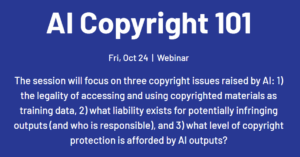
Join ARL and Authors Alliance for an essential discussion on how recent landmark court decisions are shaping the landscape of AI and copyright law. This webinar is open to the public.
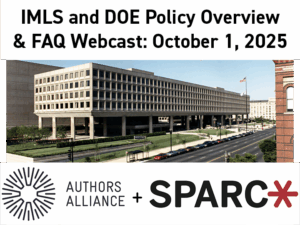
In response to the 2022 Nelson Memo, federal agencies are required to update their public access policies by the end of this year. New policies are now in effect for several agencies: the NIH, CDC, AHRQ, DOE, and NASA. On August 5th at 1pm ET / 10am PT, Authors Alliance and SPARC will host a webcast focusing on new publications sharing requirements, providing an overview of key elements of these policies, highlighting the differences between them, and answering participants’ questions. You can register for the August 5th event here.
The NIH Public Access Policy is in effect as of July 1, 2025. In response, Authors Alliance and SPARC have created a form to collect information about challenges or questions faced by authors, librarians and their institutions in complying with the roll out of new public access policies by federal grant making agencies in compliance with the OSTP directive to make federally funded research freely available to the public immediately upon publication.
“Market dilution” suggests that “using copyrighted books to train an LLM might harm the market for those works because it enables the rapid generation of countless works that compete with the originals, even if those works aren’t themselves infringing.”
Our law student intern this semester studied the legal and practical challenges facing TDM researchers. She shares her key takeaways.
Authors Alliance is pleased to announce the availability of research grants of up to $20,000 to support research projects at the intersection of artificial intelligence, copyright law, and the public interest.
This blog post reflects on the legislative history and jurisprudence behind Section 9(3) of CDPA—a provision that purports to offer copyright protection for computer-generated works.